
SKILL.md
/iblai-vibe-readme
Write or refresh the project's README.md in the standard ibl.ai format — the same shape used by vibe-starter and the reference apps in iblai/vibe. The README tells humans what the project is, how to run it, how to build native shells, how to ship releases, and how to contribute — with consistent section headings, badges, and conventions across every ibl.ai app.
What This Skill Does
- Read
package.jsonto derive the project name, version, description,
and scripts (dev, build, start, release).
- Detect which features are wired (auth, chat, analytics, native builds,
Docker) by inspecting source files and dependencies — only document what's actually present.
- Check whether
README.mdalready exists. - If it exists, merge the standard sections into it (do not clobber
custom prose the maintainers wrote). Replace stale ibl.ai sections with the updated versions below.
- If it does not exist, create it from the full template below.
- Verify there are no broken internal links (
docs/screenshots/...,
CLAUDE.md, AGENTS.md) and warn the user about any that are missing.
Step 0: Inspect the Project
Before writing, gather these inputs:
| Source | Reads | |
|---|---|---|
package.json |
name, version, description, scripts.{dev,build,start,release} |
|
iblai.env |
DOMAIN, PLATFORM (+ optional IBLAI_USERNAME) |
|
Dockerfile |
Presence → include the Docker section | |
next.config.{ts,mjs,js} |
output: 'export' → static mode; otherwise server mode (for the Deploy section copy) |
|
src-tauri/tauri.conf.json |
Presence → include the Native builds section AND keep the Deploy section (mobile dev builds use the hosted URL) | |
| `app/(onboarding | onboarding)/, app/sso-login*` |
Presence → list under features |
CLAUDE.md / AGENTS.md |
Presence → cross-link them | |
docs/screenshots/*.png |
Use existing names; do NOT invent missing files |
Do NOT invent feature rows for surfaces that don't exist. The feature table should mirror what the codebase actually ships.
Step 1: Check for Existing README.md
Read README.md in the current working directory. If it exists:
- Preserve any custom narrative (e.g. company-specific context, a
"What is X" paragraph, hand-written contributing guidelines).
- Replace standardized sections (badges, "Quick Start", "Built With",
"Native builds", "Project Structure", "Releasing") with the templates below — these go stale fast and should track the canonical format.
- If a
## ibl.aiboilerplate section exists from a prior run, replace
it with the updated version below.
If README.md does not exist, write the full template.
Step 2: Write the README Content
The template below mirrors the standard ibl.ai README. Adapt the placeholders in {{ ... }} to the values you derived in Step 0, drop sections whose features aren't present (Docker, Native builds, Releasing), and keep the section order.
Template
<div align="center">
<a href="https://ibl.ai"><img src="https://ibl.ai/images/iblai-logo.png" alt="ibl.ai" width="300"></a>
# {{ Project Title }}
{{ One-sentence tagline, under 140 chars. }}
[](https://nextjs.org)
[](https://www.typescriptlang.org)
[](https://tailwindcss.com)
[](https://claude.ai)
</div>
---
## What is {{ Project Title }}
{{ 2-3 sentence project pitch. Mention `@iblai/iblai-js` and `iblai.app`. }}
| Feature | Description |
|---------|-------------|
{{ One row per real feature in the codebase. Examples:
| **Chat** | Full agent chat at `/platform/{tenant}/{mentor}` via the SDK `<mentor-ai>` web component — streaming, sessions, files, voice |
| **Explore Agents** | Browse starred / featured / custom / community agents with the SDK `<AgentSearch>` component |
| **Edit Agent** | Per-agent dialog wired to the SDK `Agent*Tab` components (Settings, LLM, Prompts, Tools, Memory, Safety, History, Datasets, API, Embed) |
| **Profile** | Edit basic info, social links, education, experience, resume, and avatar |
| **Account** | Organization settings, user management, integrations, advanced, and billing tabs |
| **Analytics** | Agent and learner analytics dashboards (usage, courses, programs, users, topics, transcripts, financial, reports) |
| **Notifications** | Header dropdown showing recent notifications and unread badge |
| **Tenant Switching** | Switch between organizations from the avatar dropdown |
| **SSO Authentication** | Login via iblai.app — no tokens to manage |
}}
{{ Reference 1-3 screenshots from `docs/screenshots/`. Drop this block if
none exist. }}

## AGENTS.md / CLAUDE.md
Please refer to `CLAUDE.md` at the repository root for component priorities,
SDK import conventions, and the env-setup flow Claude Code should follow
when running the app for the first time.
## Quick Start
### Prerequisites
- Node.js 18+
- pnpm (fall back to npm only if unavailable)
- An ibl.ai platform login (or a tenant you can SSO into via [iblai.app](https://iblai.app))
### Install & Run
pnpm install --ignore-scripts pnpm dev
> Run with `--ignore-scripts` to skip package lifecycle (postinstall) scripts.

Open [http://localhost:3000](http://localhost:3000). {{ One sentence on
what happens after the first request — e.g. SSO redirect / home redirect
to a default route. }}

URL defaults live in `lib/iblai/config.ts`; copy `.env.example` to
`.env.local` and set `NEXT_PUBLIC_MAIN_TENANT_KEY` (plus `IBLAI_API_KEY`
for server-side platform calls).

### Build
pnpm build pnpm start
{{ INCLUDE if `Dockerfile` exists }}

### Docker
docker build -t {{ image-name }}:{{ version }} {{ flags }} . docker run -p {{ port }}:{{ port }} \ -e NEXTPUBLICMAINTENANTKEY=your-platform \ {{ image-name }}:{{ version }}
{{ INCLUDE this **Deploy** subsection whenever the project can ship a web
deployment (it covers both static `output: 'export'` Tauri shells and
server-rendered Next.js apps). Drop only if the project is explicitly
self-hosted. Full guide:
[`/iblai-vibe-ops-deploy`](https://github.com/iblai/vibe/blob/main/skills/iblai-vibe-ops-deploy/SKILL.md). }}
### Deploy
Deploy through the ibl.ai platform's hosting API (Vercel-backed) with
[`/iblai-vibe-ops-deploy`](https://github.com/iblai/vibe/blob/main/skills/iblai-vibe-ops-deploy/SKILL.md).
No Vercel account or token — auth is the platform API key (`TOKEN`) in
`iblai.env`. The skill zips the app (the `out/` export in static mode, the
project source in server mode), uploads it, polls until the build is
READY, and prints the live `*.vercel.app` URL Vercel reports. Re-run it
to redeploy; attach custom domains via the hosting DNS endpoint (the skill
returns the DNS records to add).
**Going back to local** (Tauri dev builds): remove `devUrl` from
`src-tauri/tauri.conf.json` and the WebView loads local static files
again.
{{ INCLUDE if `src-tauri/tauri.conf.json` exists. Mirror the structure
in `/iblai-vibe-ops-build` — one subsection per platform (iOS / Android /
macOS / Linux / Surface), each with a screenshot and the relevant
`pnpm exec tauri …` commands. Do NOT duplicate the full skill — keep
each platform to ~6–8 lines and link to the canonical guide. }}
### Native builds (iOS, Android, macOS, Linux, Surface)
Wrap the app in a native shell with [Tauri v2](https://tauri.app) using
Tauri directly (`pnpm exec tauri …`) (full guide:
[`/iblai-vibe-ops-build`](https://github.com/iblai/vibe/blob/main/skills/iblai-vibe-ops-build/SKILL.md)).
{{ Include only the platforms the project actually targets. Each
subsection follows this pattern:
#### iOS
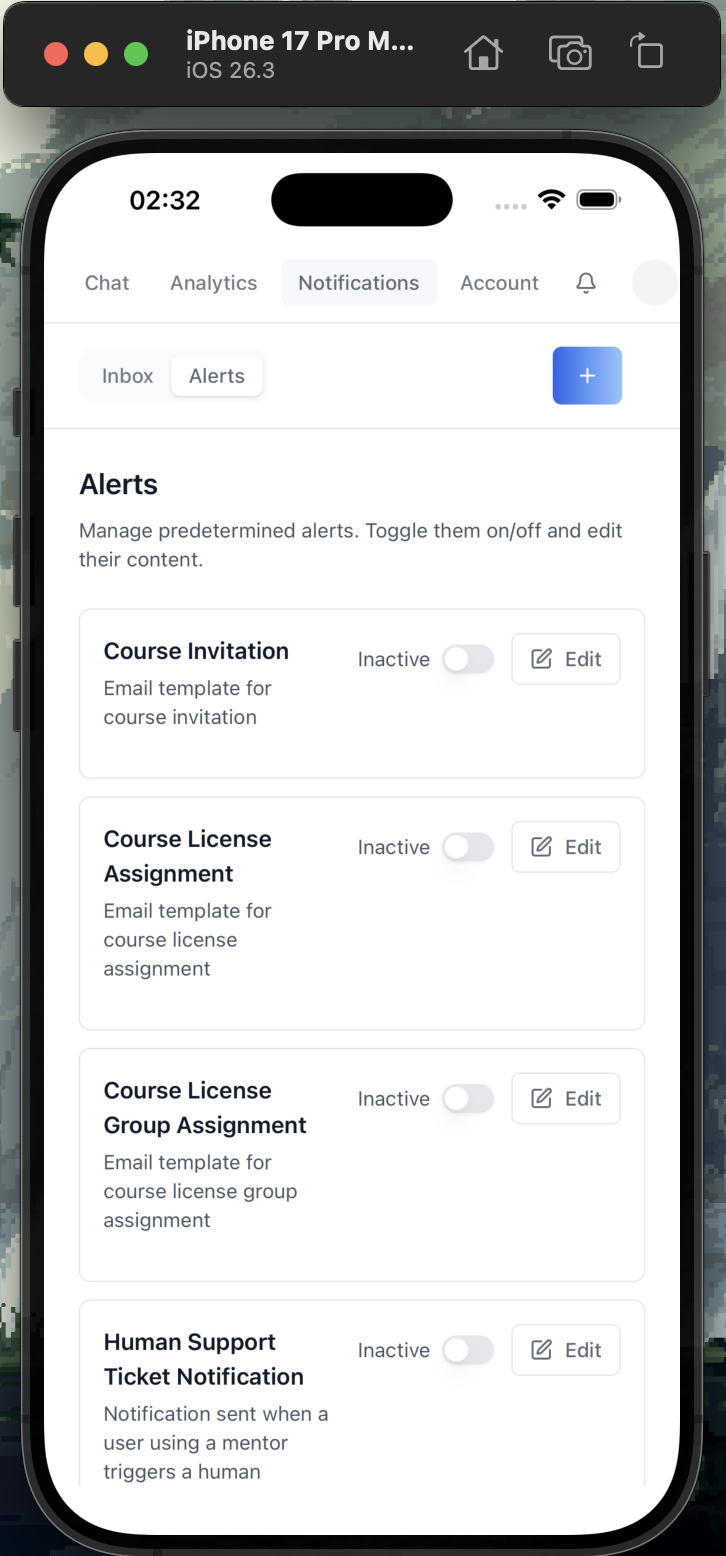
rustup target add aarch64-apple-ios aarch64-apple-ios-sim pnpm exec tauri ios init # one-time xcrun simctl list devices # list simulators pnpm exec tauri ios dev "iPhone 16 Pro Max" # run on simulator pnpm exec tauri ios build # produce .ipa
CI: copy assets/tauri/workflows/tauri-build-ios.yml.j2 (see /iblai-vibe-ops-build) # generate App Store CI
}}

{{ INCLUDE if `package.json` has a `release` script using release-it }}

### Releasing

Releases are automated via [`release-it`](https://github.com/release-it/release-it)
+ GitHub Actions. {{ Brief description of the release flow — pushes to
main, version bumps, CHANGELOG, GitHub Release, Docker image build, etc. }}

## Project Structure
{{ Tree of app/, components/, lib/iblai/, providers/ — showing only directories and the most important files. Trim to fit on one screen. }}
## Built With

- [Next.js](https://nextjs.org) — App Router
- [@iblai/iblai-js](https://www.npmjs.com/package/@iblai/iblai-js) — SDK for auth, UI components, and data
{{ Add `@iblai/iblai-web-mentor`, `<mentor-ai>` etc. only if used }}
- [Tailwind CSS](https://tailwindcss.com) — utility-first styling with ibl.ai design tokens
- [shadcn/ui](https://ui.shadcn.com) — accessible UI primitives
- [iblai.app](https://iblai.app) — production backend for auth, AI agents, billing, and analytics

## Contributing

### Setup

1. Fork the repo and clone it
2. Install dependencies: `pnpm install --ignore-scripts` (skips package lifecycle scripts)
3. Start the dev server: `pnpm dev`

### Development Workflow

1. Create a branch from `main`: `git checkout -b feat/my-feature`
2. Make your changes
3. Run `pnpm build` to verify the build passes
4. Commit and push your branch
5. Open a pull request against `main`

### Guidelines

- **Use ibl.ai SDK components first** — do not build custom components when an SDK equivalent exists
- **Use shadcn/ui for custom UI** — install via `npx shadcn@latest add <component>`, not raw HTML or third-party libraries
- **Do not override SDK styles** — SDK components ship with their own styling
- **Use SDK design tokens** — reference CSS variables like `var(--primary-color)`, `var(--border-color)`, `var(--text-secondary)` instead of hardcoded colors
- **Use `pnpm`** as the package manager

### Adding Features

Use the Claude Code skills to add new features:

- `/iblai-vibe-auth` — SSO authentication
- `/iblai-vibe-profile` — user profile
- `/iblai-vibe-account` — account/org settings
- `/iblai-vibe-analytics` — analytics dashboard
- `/iblai-vibe-notification` — notification bell
- `/iblai-vibe-invite` — invite dialogs

See `CLAUDE.md` for the full list of skills and component priority rules.

## Resources

- [ibl.ai Documentation](https://ibl.ai/docs)
- [@iblai/iblai-js](https://www.npmjs.com/package/@iblai/iblai-js) — the ibl.ai SDK
- [@iblai/mcp](https://www.npmjs.com/package/@iblai/mcp) — MCP server for AI-assisted development
- [Vibe](https://github.com/iblai/vibe) — developer toolkit for building with ibl.ai
- [Vibe Starter](https://github.com/iblai/vibe/tree/main/skills/iblai-vibe-ops-init/assets/vibe-starter) — pre-wired Next.js + ibl.ai SSO template
{{ Add other public repo links the user wants discoverable }}

---

<sub>{{ Optional: a one-line bootstrap credit. Drop if nothing applies. }}</sub>
Step 3: Validate Links
After writing, scan the README for paths that should resolve in the repo and warn the user about any that are missing:
| Path | Required when |
|---|---|
docs/screenshots/*.png |
The README references screenshots — drop the <img> tags if the files don't exist instead of leaving broken links |
CLAUDE.md |
Always — link is in the AGENTS.md / CLAUDE.md callout |
AGENTS.md |
Optional — only mention it if the file exists |
Dockerfile |
If the Docker section is present |
src-tauri/tauri.conf.json |
If the Native builds section is present |
.github/workflows/release.yml |
If the Releasing section is present |
Do NOT silently add <img> tags to files that don't exist. If a screenshot is missing, drop the line and tell the user which capture is needed.
Step 4: Confirm
After writing the file, tell the user:
Updated
README.mdto the ibl.ai standard format. The badges, Quick
Start, Native builds, Releasing, Project Structure, and Contributing
sections are now consistent with the bundled vibe-starter template and
the reference apps iniblai/vibe. {{ If you skipped any sections (e.g. no
Dockerfile present) }}, mention them so the maintainers know the
README adapts as those features land.
Important Notes
- Source of truth: the bundled starter's README at
skills/iblai-vibe-ops-init/assets/vibe-starter/README.md plus the per-skill READMEs, both in iblai/vibe. When updating this skill, diff against the latest main of that repo and pull through structural changes.
- Do not reference internal repos. Only the public, open-source
iblai/vibe repository (including the bundled vibe-starter under skills/iblai-vibe-ops-init/assets/) is citable from a generated README.
- No marketing prose: Keep claims grounded in what the codebase
actually ships. Don't add features the project hasn't implemented.
- Badges: Always include Next.js + TypeScript + Tailwind + Claude
Code. Add other badges (e.g. CI status, npm version) only when they're meaningful for the project.
- Screenshots: Reference real files in
docs/screenshots/. Don't
generate placeholders — ask the user to capture them.
- Don't link to non-existent skills: Cross-references to other
/iblai-vibe-* skills are fine; cross-references to skills that don't exist are not.
- Deploy to Vercel section. Always include the Deploy to Vercel
subsection unless the project is explicitly self-hosted with no Vercel target. The deploy works for both static output: 'export' Tauri shells and server-rendered Next.js apps (the mode is detected from next.config). See /iblai-vibe-ops-deploy for the full deploy procedure.