
SKILL.md
/iblai-vibe-profile
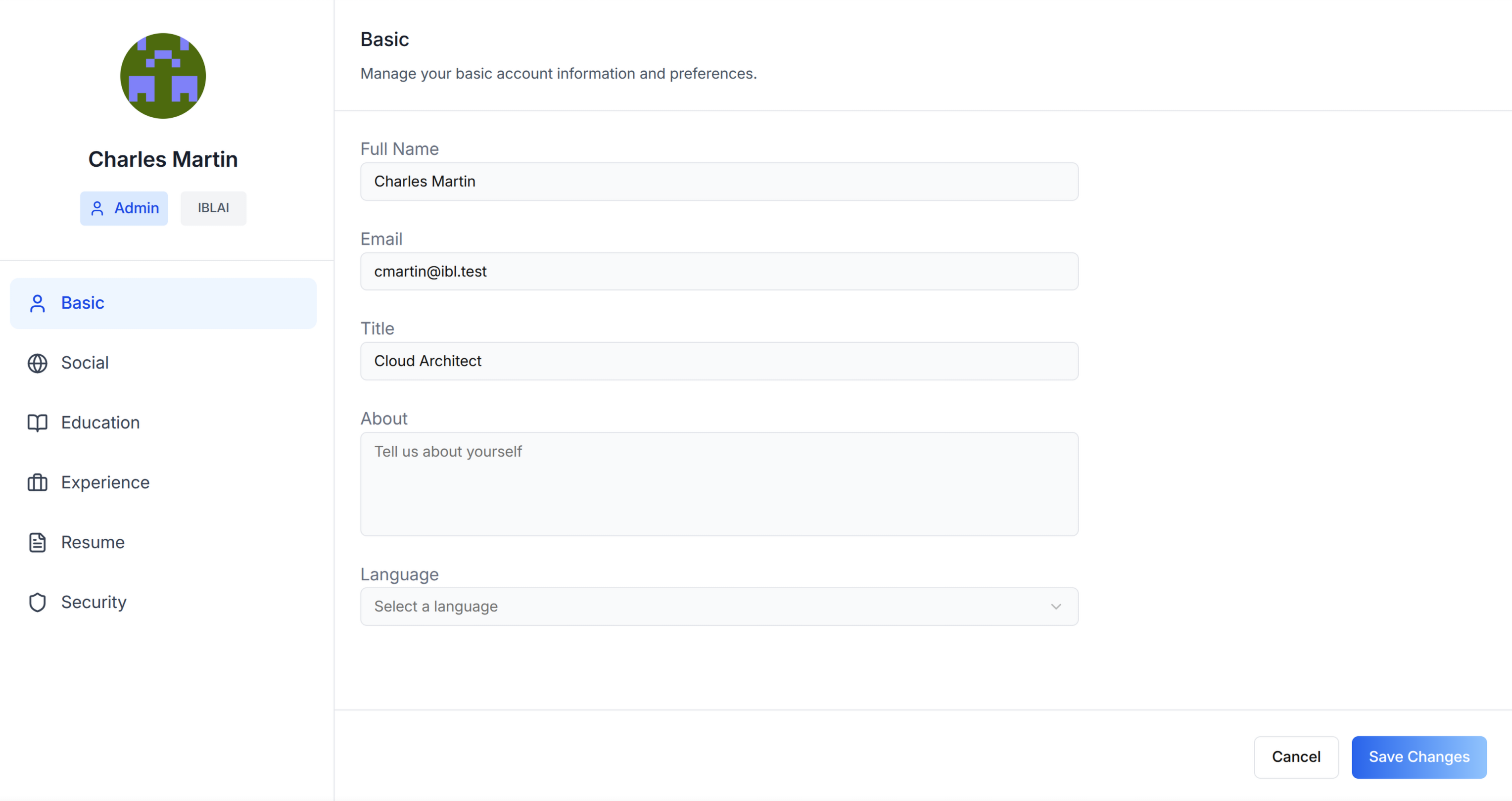
Add user profile features -- a compact avatar dropdown for your navbar and a full settings page with sidebar tabs for Basic info, Social links, Education (with Credentials and Skills sub-tabs), Experience (with a Resume sub-tab), Purchases, Memory, Privacy, History, and Security — several of them feature-gated per tenant (see the tab table below).
Template: the dropdown this skill creates is bundled as
[assets/profile-dropdown.tsx.j2](assets/profile-dropdown.tsx.j2). See
[/iblai-vibe-scaffold](../iblai-vibe-scaffold/SKILL.md) for the{{ }}contract.
Do NOT add custom styles, colors, or CSS overrides to ibl.ai SDK components. They ship with their own styling. Keep the components as-is. Do NOT implement dark mode unless the user explicitly asks for it.
When building custom UI around SDK components, use the ibl.ai brand:
- Primary:
#0058cc, Gradient:linear-gradient(135deg, #00b0ef, #0058cc) - Button:
bg-gradient-to-r from-[#2563EB] to-[#93C5FD] text-white - Font: System sans-serif stack, Style: shadcn/ui new-york variant
- Follow the component hierarchy: use ibl.ai SDK components
(@iblai/iblai-js) first, then shadcn/ui for everything else (npx shadcn@latest add <component>). Do NOT write custom components when an ibl.ai or shadcn equivalent exists. Both share the same Tailwind theme and render in ibl.ai brand colors automatically.
- Follow BRAND.md for
colors, typography, spacing, and component styles.
You MUST run /iblai-vibe-ops-test before telling the user the work is ready.
After all work is complete, start a dev server (pnpm dev) so the user can see the result at http://localhost:3000.
iblai.env is NOT a .env.local replacement — it only holds the 3 shorthand variables (DOMAIN, PLATFORM, TOKEN). Next.js still reads its runtime env vars from .env.local.
Use pnpm as the default package manager. Fall back to npm if pnpm is not installed. The generated app should live in the current directory, not in a subdirectory.
When building a navbar or header, do NOT display the tenant/platform name. Use the ibl.ai logo instead.
Navbar: If the user wants a navbar with the profile dropdown, guide
them to/iblai-vibe-navbarfirst. That skill creates the full navbar with
logo, page links, notification bell, and profile dropdown.
Common setup (brand, conventions, env files, verification): see docs/skill-setup.md.
Step 0: Start from vibe-starter? (new projects)
Before running this skill, ask the user:
Are you starting a new project from scratch? vibe-starter
(https://github.com/iblai/vibe/tree/main/skills/iblai-vibe-ops-init/assets/vibe-starter) already ships the profile
dropdown and /profile page wired up, alongside auth, navbar, and
account/notifications. Want to use that instead?
If yes, copy the bundled starter template from the installed iblai-vibe-ops-init skill's assets/vibe-starter/ directory (a sibling of this skill's directory), or fetch it from the vibe repo if those assets are not installed -- tell the user which path you took -- then skip this skill:
cp -a <skills-dir>/iblai-vibe-ops-init/assets/vibe-starter/. . # or, without local assets: git clone --depth 1 https://github.com/iblai/vibe.git vibe-tmp && cp -a vibe-tmp/skills/iblai-vibe-ops-init/assets/vibe-starter/. . && rm -rf vibe-tmp
pnpm install --ignore-scripts
Run with
--ignore-scriptsto skip package lifecycle (postinstall) scripts.
If they prefer to add the profile features to an existing app, continue below.
Prerequisites
- Auth must be set up first (
/iblai-vibe-auth) - MCP server + skills configured (
@iblai/mcpin.mcp.json)
Step 1: Check Environment
Before proceeding, check for a iblai.env in the project root. Look for PLATFORM, DOMAIN, and TOKEN variables. If the file does not exist or is missing these variables, tell the user: "You need an iblai.env with your platform configuration. Download the template and fill in your values: curl -o iblai.env https://raw.githubusercontent.com/iblai/vibe/refs/heads/main/iblai.env"
Step 2: Create the Dropdown
Render [assets/profile-dropdown.tsx.j2](assets/profile-dropdown.tsx.j2) into components/iblai/profile-dropdown.tsx (substitute {{ }} placeholders).
Files created
| File | Purpose |
|---|---|
components/iblai/profile-dropdown.tsx |
Avatar dropdown for the navbar: profile, tenant switcher (admins only), and logout |
The dropdown reads userData, currenttenant, and tenants from localStorage. Admin status is derived from the tenants array by matching the current tenant key against isadmin. The avatar is fetched internally by the SDK from the user metadata, keyed on username (use user_nicename) — with a Gravatar fallback (enableGravatarOnProfilePic) and then initials.
The dropdown shows: Profile (opens the SDK profile modal), a Tenant Switcher (admins only — see Step 4), and Logout. The dedicated "Account" item is off (showAccountTab={false}); account settings live on the separate /account page.
Step 3: Add a Full Profile Page
Step 2 creates the dropdown only. You must create the profile page manually using the Profile component (not UserProfileModal, which renders as a dialog).
Import Profile from @iblai/iblai-js/web-containers (the framework-agnostic bundle, NOT the /next bundle). This renders an inline, full-page profile editor with sidebar navigation on desktop and tabbed navigation on mobile.
Reference implementation
// app/(app)/profile/page.tsx
"use client";

import { useEffect, useState } from "react";
import { Profile } from "@iblai/iblai-js/web-containers";
import { resolveAppTenant } from "@/lib/iblai/tenant";

export default function ProfilePage() {
  const [tenantKey, setTenantKey] = useState("");
  const [username, setUsername] = useState("");
  const [isAdmin, setIsAdmin] = useState(false);
  const [ready, setReady] = useState(false);

  useEffect(() => {
    try {
      const raw = localStorage.getItem("userData");
      if (raw) {
        const parsed = JSON.parse(raw);
        setUsername(parsed.user_nicename ?? parsed.username ?? "");
      }
    } catch {}

    const resolved = resolveAppTenant();
    setTenantKey(resolved);

    try {
      const tenantsRaw = localStorage.getItem("tenants");
      if (tenantsRaw) {
        const parsed = JSON.parse(tenantsRaw);
        const match = parsed.find((t: any) => t.key === resolved);
        if (match) setIsAdmin(!!match.is_admin);
      }
    } catch {}

    setReady(true);
  }, []);

  if (!ready || !tenantKey) {
    return (
      <div className="flex flex-1 items-center justify-center">
        <p className="text-sm text-gray-400">Loading profile...</p>
      </div>
    );
  }

  return (
    <div className="mx-auto w-full flex-1 overflow-auto px-4 py-8 md:w-[75vw] md:px-0">
      <div className="rounded-lg border border-[var(--border-color)] bg-white overflow-hidden">
        <Profile
          tenant={tenantKey}
          tenants={tenants}
          username={username}
          isAdmin={isAdmin}
          onClose={() => {}}
          customization={{
            showPlatformName: true,
            useGravatarPicFallback: true,
          }}
          targetTab="basic"
        />
      </div>
    </div>
  );
}
Key patterns
- White container wrapper: The SDK Profile component has no outer background.
Wrap it in a bg-white rounded-lg border container so it renders as a card against the gray page background (--sidebar-bg: #fafbfc).
ProfilevsUserProfileModal:Profilerenders inline (full page).
UserProfileModal renders as a dialog overlay. Use Profile for a dedicated /profile route.
- Import path:
@iblai/iblai-js/web-containers(NOT/next).
Step 4: Tenant Switcher
The template already wires the tenant switcher to match the reference app — it's shown to admins only (showTenantSwitcher={isAdmin}) and fed by two localStorage reads:
userTenants(fromtenants) — populates the switch list. Without it
the switcher never appears, even when showTenantSwitcher is true.
currentTenant(fromcurrent_tenant) — the FULL active-tenant object.
The SDK uses it to label the current tenant; without it the switcher falls back to a generic label.
Why admins only: for a non-admin the SDK renders just the current tenant name with no working switch list — a dead row. The reference app hides it for non-admins; the template does the same. To show it to everyone, set showTenantSwitcher to a constant true (or userTenants.length > 1).
The
maintenant displays as "Community". That's the SDK's built-in
name for themainorg — it is NOT read fromcurrenttenant.platformname,
and passingcurrentTenantdoes not change it. It's not a bug; other
tenants show their own name.
Step 5: Use MCP Tools for Customization
get_component_info("UserProfileDropdown")
get_component_info("Profile")
get_component_info("MediaBox")
get_component_info("ResumeTab")
Profile tabs
The sidebar tabs the Profile component renders, with the targetTab id and when each appears:
| Tab | targetTab id |
Shown when | Notes |
|---|---|---|---|
| Basic | basic |
Always | Full name, email, title, about, language |
| Social | social |
Always | Social links |
| Gradebook | gradebook |
customization.showGradebookTab |
Credentials + skills gradebook |
| Education | education |
Always | Sub-tabs: Education / Credentials / Skills |
| Experience | experience |
Always | Sub-tabs: Experience / Resume |
| Purchases | purchases |
Tenant has monetization enabled | Purchase history |
| Memory | memory |
enableMemoryTab prop AND tenant memsearch on |
The user's own global memories + capture/personalization toggles (the admin view of the same data is /iblai-vibe-memory) |
| Privacy | privacy |
Tenant allows user chat-privacy control | "Private Mode" — see the Chat Privacy Settings API below |
| History | chatHistory |
Own profile only (hidden on read-only previews) | Conversations + Exports — documented in /iblai-vibe-history |
| Security | security |
Own profile only | Password reset, account deletion |
| Advanced | advanced |
Tauri desktop with localLLMProps.isAvailable |
Local LLM models — see /iblai-vibe-local-llm |
Profile Content API
Full REST reference: /iblai-api-profile in iblai/api (npx skills add iblai/api).
The SDK Profile component handles all API calls internally. If you need to build custom profile UIs or interact with profile data programmatically, here are the APIs each tab uses.
Read before write. When calling these REST endpoints directly (e.g. via fetch or curl), always GET the current data first, merge your changes into it, then POST/PUT the full object back. Most endpoints replace the entire resource -- they do NOT merge fields. Skipping the read will silently erase fields you didn't include in the payload.
# 1. Read current state
curl -s "{dmUrl}/api/career/orgs/{org}/education/users/alice/" \
  -H "Authorization: Token {dm_token}" > education.json

# 2. Merge your changes into the existing data
# 3. Write back the full object
curl -X PUT "{dmUrl}/api/career/orgs/{org}/education/users/alice/?id={education_id}" \
  -H "Authorization: Token {dm_token}" \
  -H "Content-Type: application/json" \
  -d @education.json
This applies to all profile endpoints: education, experience, and resume.
Service
Profile data lives in the DM (data manager) service:
| Service | Base URL | Auth Header | Manages |
|---|---|---|---|
| DM | config.dmUrl() |
Authorization: Token {dm_token} |
Education, experience, companies, institutions, resume |
Basic, Social, and Profile Image
Basic info (name, email, title, bio, language), social links, profile image, and password reset are user-scope and not exposed via the platform Api-Token. Use the SDK Profile component, which handles these via the user's session — no direct REST endpoints are documented here.
Education Tab
CRUD operations for education entries. Uses the DM career API.
GET    {dmUrl}/api/career/orgs/{org}/education/users/{username}/
POST   {dmUrl}/api/career/orgs/{org}/education/users/{username}/
PUT    {dmUrl}/api/career/orgs/{org}/education/users/{username}/?id={education_id}
DELETE {dmUrl}/api/career/orgs/{org}/education/users/{username}/?id={education_id}
Education schema:
{
  id: number;
  institution: { id: number; name: string };
  institution_id: number;        // required for create/update
  degree: string;
  field_of_study: string;
  start_date: string;            // "YYYY-MM-DD"
  end_date: string | null;
  is_current: boolean;
  grade: string;
  activities: string;
  description: string;
  data: Record<string, any>;     // arbitrary metadata
  metadata: Record<string, any>;
}
Institutions (lookup for the institution picker):
GET  {dmUrl}/api/career/orgs/{org}/institutions/users/{username}/
POST {dmUrl}/api/career/orgs/{org}/institutions/users/{username}/
Institution create payload:
{ name: string; institution_type: InstitutionTypeEnum; established_year?: number }Experience Tab
CRUD operations for professional experience entries.
GET    {dmUrl}/api/career/orgs/{org}/experience/users/{username}/
POST   {dmUrl}/api/career/orgs/{org}/experience/users/{username}/
PUT    {dmUrl}/api/career/orgs/{org}/experience/users/{username}/?id={experience_id}
DELETE {dmUrl}/api/career/orgs/{org}/experience/users/{username}/?id={experience_id}
Experience schema:
{
  id: number;
  company: { id: number; name: string };
  company_id: number;            // required for create/update
  title: string;
  employment_type: string;       // "Full-time", "Part-time", "Contract", "Freelance", "Internship"
  location: string;
  start_date: string;            // "YYYY-MM-DD"
  end_date: string | null;
  is_current: boolean;
  description: string;
  data: Record<string, any>;
  metadata: Record<string, any>;
}
Companies (lookup for the company picker):
GET  {dmUrl}/api/career/orgs/{org}/companies/users/{username}/
POST {dmUrl}/api/career/orgs/{org}/companies/users/{username}/
Company create payload:
{ name: string; industry?: string; website?: string; logo_url?: string }Resume Tab
Upload and view PDF resumes.
GET  {dmUrl}/api/career/resume/orgs/{org}/users/{username}/
POST {dmUrl}/api/career/resume/orgs/{org}/users/{username}/
PUT  {dmUrl}/api/career/resume/orgs/{org}/users/{username}/
Upload (FormData):
user: {username}
platform: {org}
resume: File          // PDF only, max 25MB -- marks as CV
additional_files: File  // general file upload (not CV)
Response:
{
  id: number;
  user: number;
  platform: string;
  files: [{ name: string; url: string; type: string }];
  links: [{ url: string }];
}
Security Tab
Account deletion.
POST {dmUrl}/api/core/users/delete/ // account deletion (self-retire)Account deletion payload: { username: string }. Password reset is user-scope and runs through the SDK / Auth SPA, not via the platform Api-Token.
RTK Query Hooks (SDK Exports)
The SDK's data-layer exports these hooks for all career operations:
import {
  useGetUserEducationQuery,
  useCreateUserEducationMutation,
  useUpdateUserEducationMutation,
  useDeleteUserEducationMutation,
  useGetUserExperienceQuery,
  useCreateUserExperienceMutation,
  useUpdateUserExperienceMutation,
  useDeleteUserExperienceMutation,
  useGetUserInstitutionsQuery,
  useCreateUserInstitutionMutation,
  useGetUserCompaniesQuery,
  useCreateUserCompanyMutation,
  useGetUserResumeQuery,
  useCreateUserResumeMutation,
} from "@iblai/iblai-js/data-layer";
For user metadata (basic/social):
import {
  useGetUserMetadataQuery,
  useUpdateUserMetadataMutation,
  useUploadProfileImageMutation,
  useGetUserMetadataEdxQuery,
  useResetPasswordMutation,
} from "@iblai/iblai-js/data-layer";
Building a Custom Career API Slice
If you need career APIs without the SDK's built-in hooks, build a standard RTK Query slice with fetchBaseQuery and one endpoint per row in the endpoint tables above. Use Authorization: Token {dm_token} (from localStorage), and tag invalidation on ["education", "experience", "institution", "company", "resume"].
User Metadata API
Full REST reference: /iblai-api-profile-metadata in iblai/api (npx skills add iblai/api).
The ibl.ai platform provides per-user metadata storage via the Agent Metadata endpoint. This is useful for storing arbitrary JSON data scoped to a specific user and agent (e.g. application progress, preferences, onboarding state).
Endpoints
GET  {dmUrl}/api/ai/mentor/orgs/{org}/users/{username}/metadata?mentor={mentorId}
POST {dmUrl}/api/ai/mentor/orgs/{org}/metadata/ body: { mentor_id, metadata }- Auth:
Authorization: Token {axd_token}(from localStorage) - Scope: Per-user, per-agent; isolated.
- Schema: Arbitrary JSON.
- Merge behavior: POST merges new keys with existing metadata
(does not replace the entire object).
AI Profile Memory API
The platform stores AI-learned facts about a user as tag/detail pairs. This powers the "AI Memory" tab in the profile modal.
GET    {dmUrl}/api/ai-mentor/orgs/{org}/users/{user_id}/ai-user-profile-memory/
POST   {dmUrl}/api/ai-mentor/orgs/{org}/users/{user_id}/ai-user-profile-memory/
DELETE {dmUrl}/api/ai-mentor/orgs/{org}/users/{user_id}/ai-user-profile-memory/{tag}/
Create/Read:
// Request
{ tag: "favorite-animal", detail: "my favorite animal is cat" }

// Response (array of entries)
[{ tag: "favorite-animal", detail: "my favorite animal is cat" }]Auth: Uses axd_token from localStorage.
Chat Privacy Settings
Users can control how their chat data is stored.
GET  {dmUrl}/api/ai-account/orgs/{org}/users/{user_id}/chat-privacy-config/
GET  {dmUrl}/api/ai-account/orgs/{org}/users/{user_id}/chat-privacy-settings/
POST {dmUrl}/api/ai-account/orgs/{org}/users/{user_id}/chat-privacy-settings/
Privacy modes: normal, anonymized, disabled
The config endpoint returns whether the platform has this feature enabled. The settings endpoint reads/writes the user's preference.
Media Upload (MediaBox)
The SDK provides a MediaBox component for file and link uploads. It renders a tabbed interface with a file upload zone and a link input field, plus a list of previously uploaded files/links.
Import
import { MediaBox, type UploadedFile } from "@iblai/iblai-js/web-containers/next";Props
| Prop | Type | Description |
|---|---|---|
uploadedMedia |
UploadedFile[] |
Previously uploaded files/links to display |
isLoading |
boolean? |
Show loading state |
isError |
boolean? |
Show error state |
isUploading |
boolean? |
Show upload-in-progress state |
resumeCheckboxEnabled |
boolean? |
Show "This is my CV" checkbox |
onUploadFile |
(file: File, isResume: boolean) => void |
Called when a file is selected |
onUploadLink |
(url: string) => void |
Called when a link is submitted |
onError |
(message: string) => void |
Called on validation errors |
UploadedFile type
interface UploadedFile {
  name: string;
  url: string;
  type?: string;  // "link" for links, MIME type for files
}
Peer dependency
MediaBox requires @tanstack/react-form:
pnpm add @tanstack/react-formBackend: Career/Resume API
MediaBox is a presentational component -- it does not handle uploads itself. You must connect it to the Career/Resume API for persistent storage:
GET/PUT/POST /api/career/resume/orgs/{org}/users/{username}/Connecting MediaBox to the Career API
import { useMemo } from "react";
import { toast } from "sonner";
import { MediaBox, type UploadedFile } from "@iblai/iblai-js/web-containers/next";
import { useGetUserResumeQuery, useCreateUserResumeMutation } from "@/services/career-api";
import { resolveAppTenant } from "@/lib/iblai/tenant";

function getUserName(): string {
  if (typeof window === "undefined") return "";
  try {
    const raw = localStorage.getItem("userData");
    return raw ? JSON.parse(raw).user_nicename ?? "" : "";
  } catch { return ""; }
}

export function DocumentUploads() {
  const org = useMemo(() => resolveAppTenant(), []);
  const username = useMemo(() => getUserName(), []);

  const { data, isLoading, isError, refetch } = useGetUserResumeQuery(
    { org, username },
    { skip: !org || !username }
  );
  const [createResume, { isLoading: isUploading }] = useCreateUserResumeMutation();

  const uploadedMedia: UploadedFile[] = useMemo(() => {
    if (!data) return [];
    const files = (data.files ?? []).map((f) => ({ name: f.name, url: f.url, type: f.type }));
    const links = (data.links ?? []).map((l) => ({ name: l.url, url: l.url, type: "link" }));
    return [...files, ...links];
  }, [data]);

  async function handleUploadFile(file: File, isResume: boolean) {
    const formData = new FormData();
    formData.append("user", username);
    formData.append("platform", org);
    formData.append(isResume ? "resume" : "additional_files", file);
    try {
      await createResume({ org, username, resume: formData, method: "POST" }).unwrap();
      toast.success("File uploaded successfully");
      refetch();
    } catch { toast.error("Failed to upload file"); }
  }

  async function handleUploadLink(url: string) {
    const formData = new FormData();
    formData.append("user", username);
    formData.append("platform", org);
    const existingLinks = data?.links ?? [];
    existingLinks.forEach((link, index) => {
      formData.append(`link_${existingLinks.length + 1 - index}`, link.url);
    });
    formData.append("link_1", url);
    try {
      await createResume({ org, username, resume: formData }).unwrap();
      toast.success("Link added successfully");
      refetch();
    } catch { toast.error("Failed to add link"); }
  }

  if (!org || !username) {
    return <p className="text-[14px] text-[#86868b]">Please sign in to upload documents.</p>;
  }

  return (
    <MediaBox
      uploadedMedia={uploadedMedia}
      isLoading={isLoading}
      isError={isError}
      isUploading={isUploading}
      resumeCheckboxEnabled={true}
      onUploadFile={handleUploadFile}
      onUploadLink={handleUploadLink}
      onError={(msg) => toast.error(msg)}
    />
  );
}
Key details
- Auth: Uses
dmtokenfrom localStorage (NOTaxdtoken) - FormData fields:
user(username),platform(org key),
resume (file, marks as CV) or additional_files (file, general upload)
- Links: Append numbered
link_Nfields. Preserve existing links when
adding a new one
- Persistent: Files are stored on the user's profile permanently
(unlike chat file uploads which are session-scoped)
Career Profile Tabs (Standalone)
The SDK also exports individual career profile tabs that can be used outside the full Profile component:
ResumeTab
import { ResumeTab } from "@iblai/iblai-js/web-containers";
<ResumeTab org={tenantKey} username={username} />
Renders a resume upload and display interface. Props: org (string), username (string).
EducationTab
import { EducationTab } from "@iblai/iblai-js/web-containers";
<EducationTab org={tenantKey} username={username} />
Renders education background management (add/edit/delete education entries). Props: org (string), username (string).
ExperienceTab
import { ExperienceTab } from "@iblai/iblai-js/web-containers";
<ExperienceTab org={tenantKey} username={username} />
Renders professional experience management. Props: org (string), username (string).
Dialogs
These companion dialogs can be used alongside the tabs:
| Component | Import | Description |
|---|---|---|
EducationDialog |
@iblai/iblai-js/web-containers |
Dialog for adding/editing education entries |
ExperienceDialog |
@iblai/iblai-js/web-containers |
Dialog for adding/editing experience entries |
CompanyDialog |
@iblai/iblai-js/web-containers |
Company selection dialog |
InstitutionDialog |
@iblai/iblai-js/web-containers |
Institution selection dialog |
<UserProfileDropdown> Props
The generated dropdown component. Import from @iblai/iblai-js/web-containers/next.
| Prop | Type | Description |
|---|---|---|
email |
string |
Required. User email (from userData.user_email); used for the Gravatar avatar fallback |
username |
string |
Username — use user_nicename (the avatar metadata fetch keys on it) |
mainPlatformKey |
string |
Required. Main/community tenant key (config.mainTenantKey()) |
tenantKey |
string |
Active tenant/org key |
currentTenant |
Tenant? |
Full active-tenant object (from current_tenant) — labels the tenant switcher |
userTenants |
Tenant[] |
Required for tenant switcher -- full tenant list from localStorage |
userIsAdmin |
boolean |
Shows admin badge + gates the tenant switcher |
userIsStudent |
boolean? |
Non-admin flag (!isAdmin) |
enableGravatarOnProfilePic |
boolean? |
Gravatar fallback when the user has no uploaded image (default true) |
showProfileTab |
boolean |
Show profile link |
showAccountTab |
boolean |
Show the dedicated "Account" item (keep false — account lives on /account) |
showTenantSwitcher |
boolean |
Show tenant switcher (needs userTenants + currentTenant); gate on userIsAdmin |
showLogoutButton |
boolean |
Show logout button |
showHelpLink |
boolean |
Show help link |
showLearnerModeSwitch |
boolean? |
Show learner/instructor mode toggle (admins) |
currentSPA |
string? |
Current app id (e.g. "mentor") — used for conditional SDK rendering |
currentPlatformBaseDomain |
string? |
Base domain for custom-domain settings (config.platformBaseDomain()) |
authURL |
string |
Auth service URL |
onLogout |
() => void |
Logout callback |
onTenantChange |
(tenant: string) => void |
Called when user switches tenant -- must set app_tenant in localStorage |
onTenantUpdate |
(tenant: Tenant) => void |
Called when tenant data updates -- must set app_tenant in localStorage |
className |
string? |
Additional CSS class |
dropdownClassName |
string? |
CSS class for dropdown panel |
avatarSize |
number? |
Avatar size in pixels |
metadata |
{ helpcenterurl?: string; show_help?: boolean } |
Platform metadata for help link |
metadataLoaded |
boolean? |
Whether metadata has finished loading |
enableMemoryTab |
boolean? |
Show AI memory management tab |
enableCatalogInvite |
boolean? |
Enable catalog invite feature |
enableRbac |
boolean? |
Enable RBAC permission checks |
isModalOpen |
boolean? |
Control profile modal open state externally |
onModalOpenChange |
(open: boolean) => void |
Callback when modal open state changes |
defaultActiveTab |
string? |
Default tab when profile modal opens |
onAccountDeleted |
() => void |
Callback after account deletion |
<Profile> Props (Full-Page Profile)
Import from @iblai/iblai-js/web-containers.
| Prop | Type | Description |
|---|---|---|
tenant |
string |
Tenant/org key |
username |
string |
Username |
isAdmin |
boolean |
Admin flag |
onClose |
() => void |
Close callback |
customization |
object |
See below |
targetTab |
string |
Initial tab id — see the Profile tabs table (basic, social, gradebook, education, experience, purchases, memory, privacy, chatHistory, security, advanced) |
enableMemoryTab |
boolean? |
Show the Memory tab (still requires tenant memsearch to be on) |
localLLMProps |
object? |
Props for local LLM tab (Tauri desktop only) |
onAccountDeleted |
() => void |
Callback after account deletion |
Customization object
{
  showMentorAIDisplayCheckbox?: boolean;  // Show "visible on MentorAI" toggle
  showLeaderboardDisplayCheckbox?: boolean;  // Show leaderboard opt-in
  showUsernameField?: boolean;  // Show username field (read-only)
  showPlatformName?: boolean;  // Show platform/tenant name badge
  useGravatarPicFallback?: boolean;  // Use Gravatar when no profile pic
}
<UserProfileModal> Props (Profile + Account Modal)
For a profile editing modal (used by the MentorAI reference app), import UserProfileModal from @iblai/iblai-js/web-containers/next. This is a dialog that combines profile editing and account settings in one overlay.
The modal shows Profile tabs (basic, social, education, experience, resume, security) and Account tabs (organization, management, integrations, billing). Billing/purchases is on the Account side, not the Profile side.
Required
| Prop | Type | Description |
|---|---|---|
isOpen |
boolean |
Whether the modal is visible |
onClose |
() => void |
Close callback |
params |
{ tenantKey: string; mentorId?: string; isAdmin?: boolean } |
Tenant key, optional agent ID and admin flag |
authURL |
string |
Auth service URL (from config.authUrl()) |
Optional
| Prop | Type | Description | |
|---|---|---|---|
tenants |
Tenant[] |
Full list of user tenants from localStorage | |
targetTab |
string |
Initial tab: basic, social, education, experience, resume, security, organization, management, integrations, billing |
|
showPlatformName |
boolean |
Show tenant name badge | |
useGravatarPicFallback |
boolean |
Use Gravatar when no profile pic | |
currentSPA |
string |
Current app identifier (e.g., "agent") |
|
currentPlatformBaseDomain |
string |
Base domain for custom domain settings | |
billingEnabled |
boolean |
Enable billing tab (requires Stripe integration) | |
billingURL |
string |
Stripe billing portal URL | |
topUpEnabled |
boolean |
Enable credit top-up | |
topUpURL |
string |
Stripe top-up URL | |
onTenantUpdate |
(tenant: Tenant) => void |
Called when tenant is updated | |
onBillingTabRequest |
`() => Promise<void> \ | void` | Called when billing tab is opened -- fetch billing data |
onUpgradeClick |
() => void |
Called when upgrade button is clicked | |
onAccountDeleted |
() => void |
Called after account deletion |
Step 6: Verify
Run /iblai-vibe-ops-test before telling the user the work is ready:
pnpm build-- must pass with zero errorspnpm test-- vitest must pass- Start dev server and touch test:
``bash pnpm dev & npx playwright screenshot http://localhost:3000/profile /tmp/profile.png ``
Important Notes
- Redux store: Must include
mentorReducerandmentorMiddleware initializeDataLayer(): 5 args (v1.2+)@reduxjs/toolkit: Deduplicated via webpack aliases innext.config.ts- Admin detection: Derived from
tenantsarray in localStorage - SDK hardcoded styles: The SDK Profile component uses
bg-whiteand
bg-gray-50 internally. Do NOT override these. Instead, wrap the component in a white container so it renders correctly against the gray page background.
- Billing vs Purchases: Tenant billing (plan, credits, spend limits)
lives on the Account page (/iblai-vibe-account, /iblai-vibe-billing). The Profile page's own Purchases tab shows the user's purchase history and only appears when the tenant has monetization enabled.
- Feature-gated tabs: Memory, Privacy, Purchases, Gradebook, and
Advanced only render when their gate is on (see the Profile tabs table) — targetTab pointing at a hidden tab falls back to nothing useful, so check the gate before deep-linking.
- Brand guidelines: BRAND.md