
SKILL.md
/iblai-vibe-billing
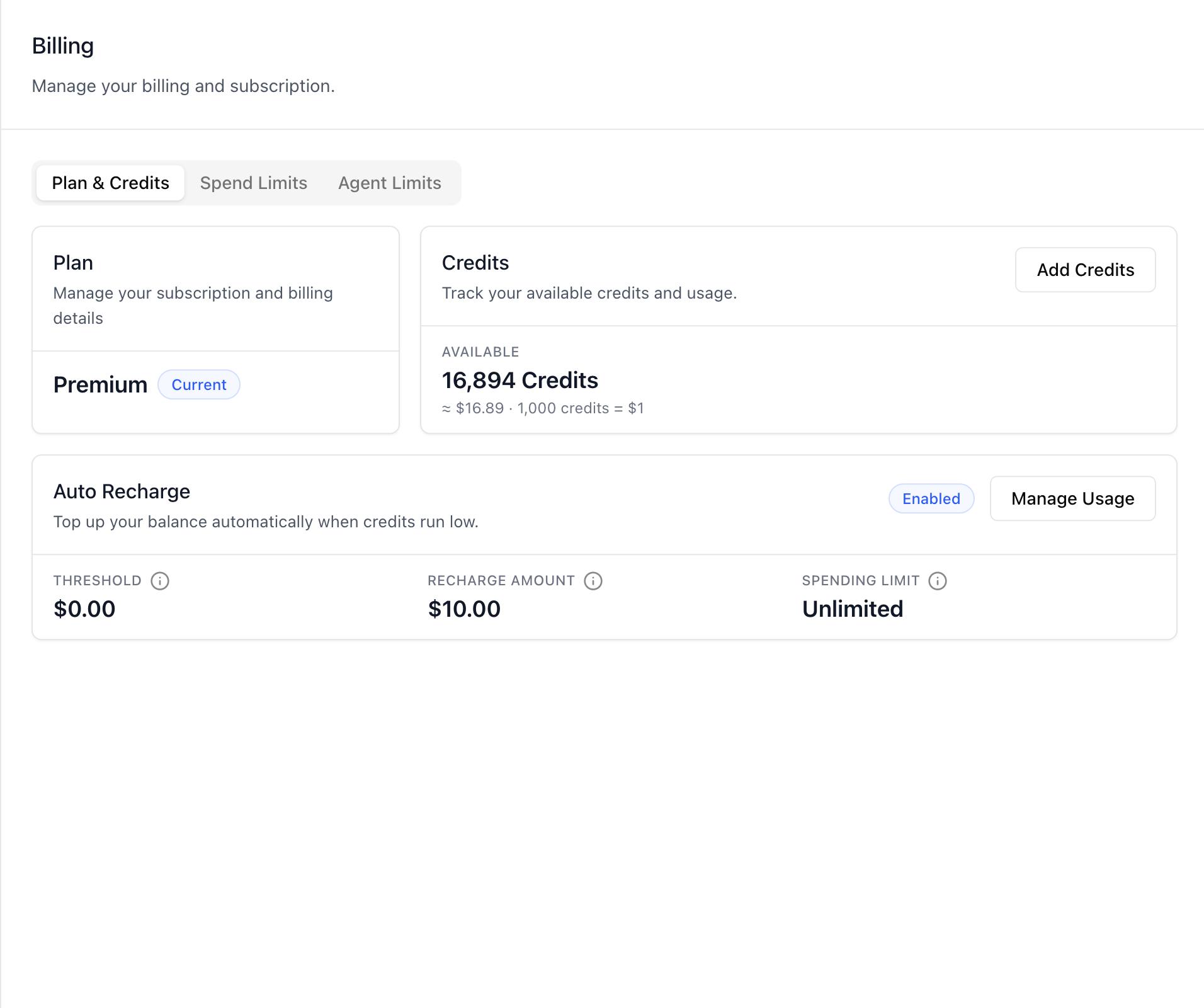
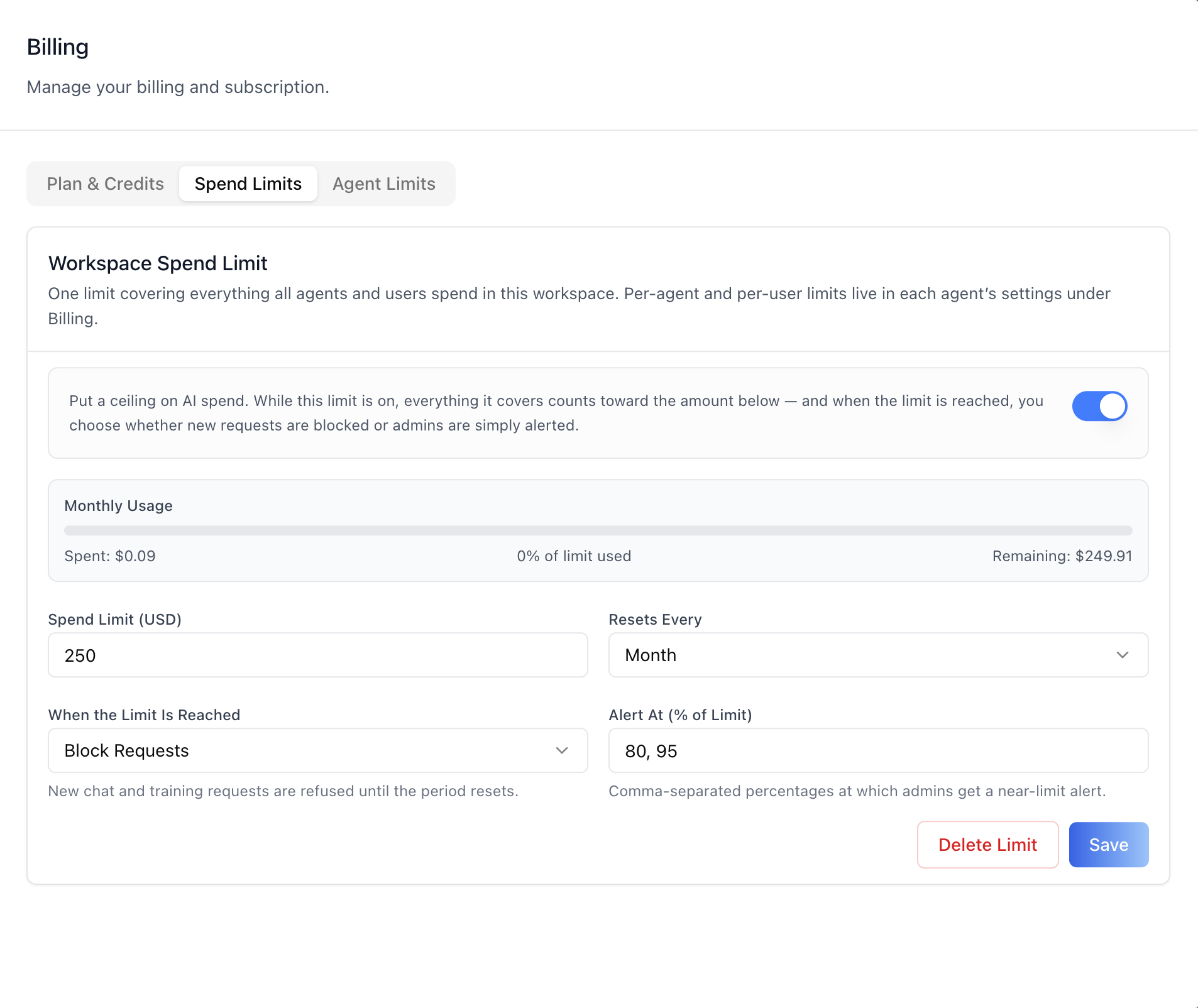
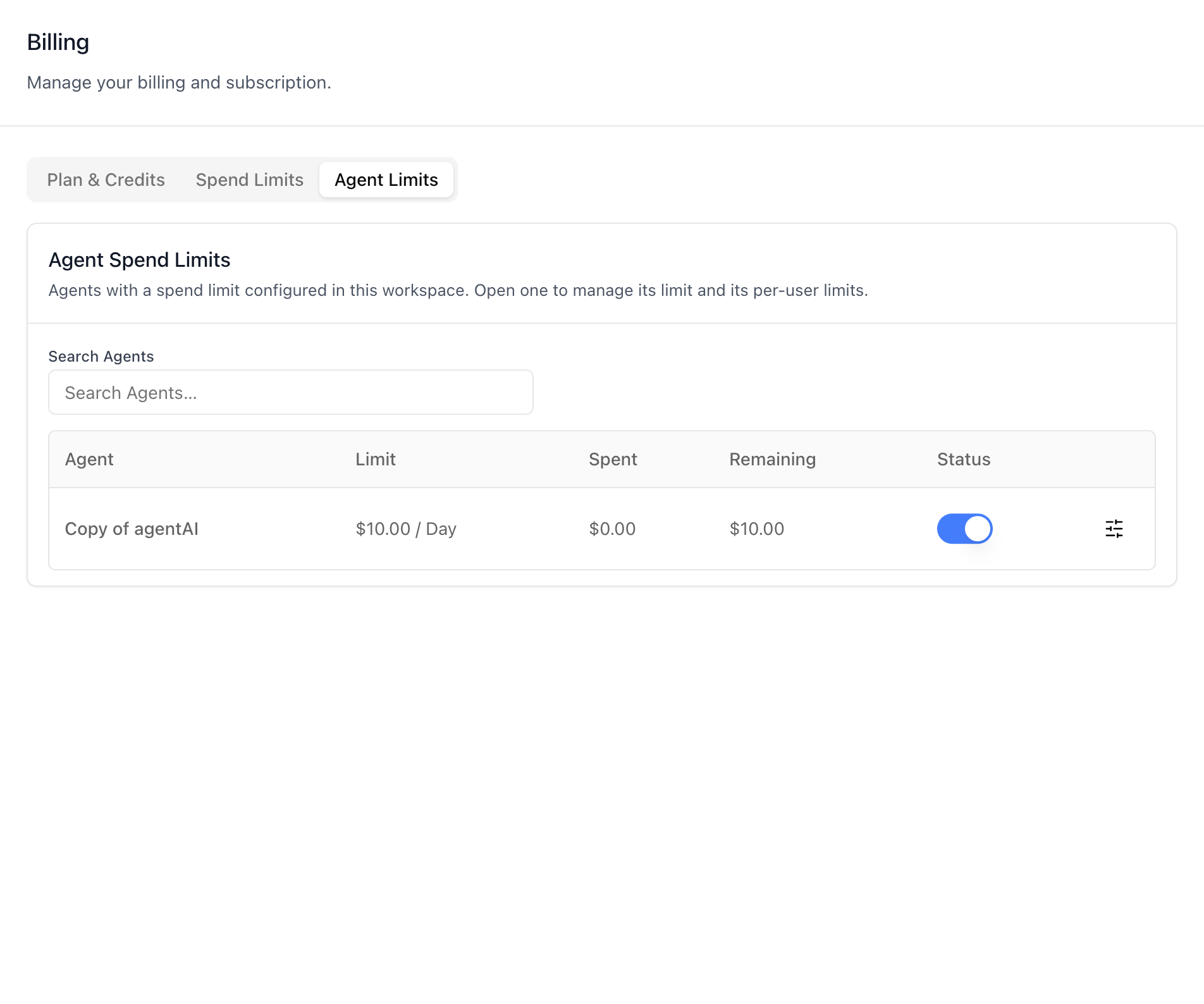
Add the tenant Billing surface -- "Manage your billing and subscription" for the whole workspace, in three tabs: Plan & Credits (current plan with Stripe upgrade, credit balance with its USD equivalent, Add Credits, and Auto Recharge with threshold / recharge amount / spending limit), Spend Limits (the single workspace-wide LLM spend limit covering everything all agents and users spend), and Agent Limits (every agent spend cap in the workspace in one searchable table — each row opens the same per-agent Billing editor documented in /iblai-vibe-agent-billing).
This is the tenant-level counterpart of the per-agent Billing tab: per-agent and per-user limits live in each agent's settings (/iblai-vibe-agent-billing); this surface holds the plan/credits management, the workspace-wide cap, and the cross-agent overview.
Do NOT add custom styles, colors, or CSS overrides to ibl.ai SDK components. They ship with their own styling. Keep the components as-is. Do NOT implement dark mode unless the user explicitly asks for it.
When building custom UI around SDK components, use the ibl.ai brand:
- Primary:
#0058cc, Gradient:linear-gradient(135deg, #00b0ef, #0058cc) - Button:
bg-gradient-to-r from-[#2563EB] to-[#93C5FD] text-white - Font: System sans-serif stack, Style: shadcn/ui new-york variant
- Follow the component hierarchy: use ibl.ai SDK components
(@iblai/iblai-js) first, then shadcn/ui for everything else (npx shadcn@latest add <component>). Do NOT write custom components when an ibl.ai or shadcn equivalent exists. Both share the same Tailwind theme and render in ibl.ai brand colors automatically.
- Follow BRAND.md for
colors, typography, spacing, and component styles.
You MUST run /iblai-vibe-ops-test before telling the user the work is ready.
After all work is complete, start a dev server (pnpm dev) so the user can see the result at http://localhost:3000.
iblai.env is NOT a .env.local replacement — it only holds the 3 shorthand variables (DOMAIN, PLATFORM, TOKEN). Next.js still reads its runtime env vars from .env.local.
Use pnpm as the default package manager. Fall back to npm if pnpm is not installed.
Common setup (brand, conventions, env files, verification): see docs/skill-setup.md.
Already have Billing?
Two sibling surfaces overlap with this one — check before mounting:
/iblai-vibe-account— the<Account>settings page already
hosts this exact component as its Billing tab (shown when billingURL or topUpURL is set). If your app uses the Account page, you likely don't need a standalone mount — deep-link with targetTab: "billing" instead.
/iblai-vibe-credit— the compact<CreditBalance>navbar
widget (plan badge, credits, add-credits/upgrade dropdown). It is a top-nav companion to this page, not a replacement.
Prerequisites
- Auth must be set up first (
/iblai-vibe-auth) - MCP server + skills configured (
@iblai/mcpin.mcp.json) - Plan upgrades, Add Credits, and Auto Recharge run through Stripe
on the ibl.ai backend — nothing to configure client-side, but the flows redirect to Stripe-hosted pages and return to your app.
- The Spend Limits / Agent Limits tabs hit RBAC-gated admin endpoints
— a user without access sees a friendly denied panel per section.
Step 1: Check Environment
Before proceeding, check for an iblai.env in the project root. Look for PLATFORM, DOMAIN, and TOKEN variables. If the file does not exist or is missing these variables, tell the user: "You need an iblai.env with your platform configuration. Download the template and fill in your values: curl -o iblai.env https://raw.githubusercontent.com/iblai/vibe/refs/heads/main/iblai.env"
Step 2: Mount BillingTab
BillingTab imports from @iblai/iblai-js/web-containers (the base bundle, not /next). It takes the tenant key plus the acting user's identity — the agent search and the Stripe flows need them.
// app/(app)/settings/billing/page.tsx
"use client";

import { useEffect, useState } from "react";
import { BillingTab } from "@iblai/iblai-js/web-containers";

export default function BillingPage() {
  const [tenant, setTenant] = useState("");
  const [username, setUsername] = useState("");
  const [email, setEmail] = useState("");

  useEffect(() => {
    try {
      const raw = localStorage.getItem("userData");
      if (raw) {
        const parsed = JSON.parse(raw);
        setUsername(parsed.user_nicename ?? parsed.username ?? "");
        setEmail(parsed.user_email ?? "");
      }
      setTenant(
        localStorage.getItem("app_tenant") ??
          localStorage.getItem("tenant") ??
          "",
      );
    } catch {}
  }, []);

  if (!tenant || !username) return null;

  return (
    <div className="flex h-full flex-col bg-white p-6">
      <BillingTab
        tenant={tenant}
        username={username}
        currentUserEmail={email}
        mainPlatformKey={process.env.NEXT_PUBLIC_MAIN_TENANT_KEY ?? ""}
      />
    </div>
  );
}
Step 3: Use MCP Tools for Customization
get_component_info("BillingTab")
get_component_info("AgentSpendCapsTab")
<BillingTab> Props
Import from @iblai/iblai-js/web-containers.
| Prop | Type | Required | Description | |
|---|---|---|---|---|
tenant |
string |
Yes | Tenant / org key this Billing page manages | |
username |
string |
Yes | Acting admin's username (Stripe portal + agent search) | |
mainPlatformKey |
string |
Yes | The main tenant key (NEXTPUBLICMAINTENANTKEY) — used to classify Free/Trial/Premium |
|
currentUserEmail |
string |
Yes | Acting user's email, passed to the Stripe upgrade flow | |
userActiveApp |
`UserApp \ | null` | No | Active subscription record (from @iblai/iblai-api) — enables renewal-date / trial-days copy on the Plan card |
redirectUrl |
string |
No | Stripe checkout return URL; defaults to the current page |
What each tab renders
Plan & Credits
- Plan card — Free / Trial / Premium label with a "Current"
badge; trial end date or renewal date when userActiveApp carries a subscription. Free and Trial plans get a gradient Upgrade button (Stripe checkout via useStripeUpgrade).
- Credits card — Available credits with the USD equivalent and
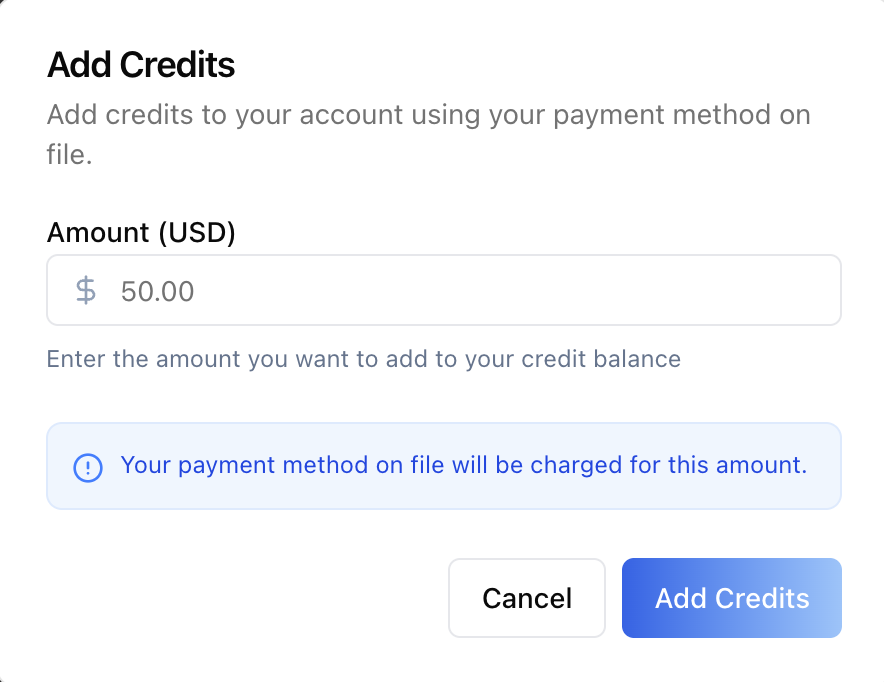
the environment's conversion rate (e.g. "≈ $16.89 · 1,000 credits = $1" — resolved from account fields, falling back to the newest top-up transaction; never hardcoded), plus Consumed and Resets-on stats when the API provides them. Add Credits opens a modal that charges the payment method on file for a dollar amount; with no payment method, the button becomes Manage Billing and opens the Stripe customer portal to add one.
- Auto Recharge section (paid plans with a payment method) —
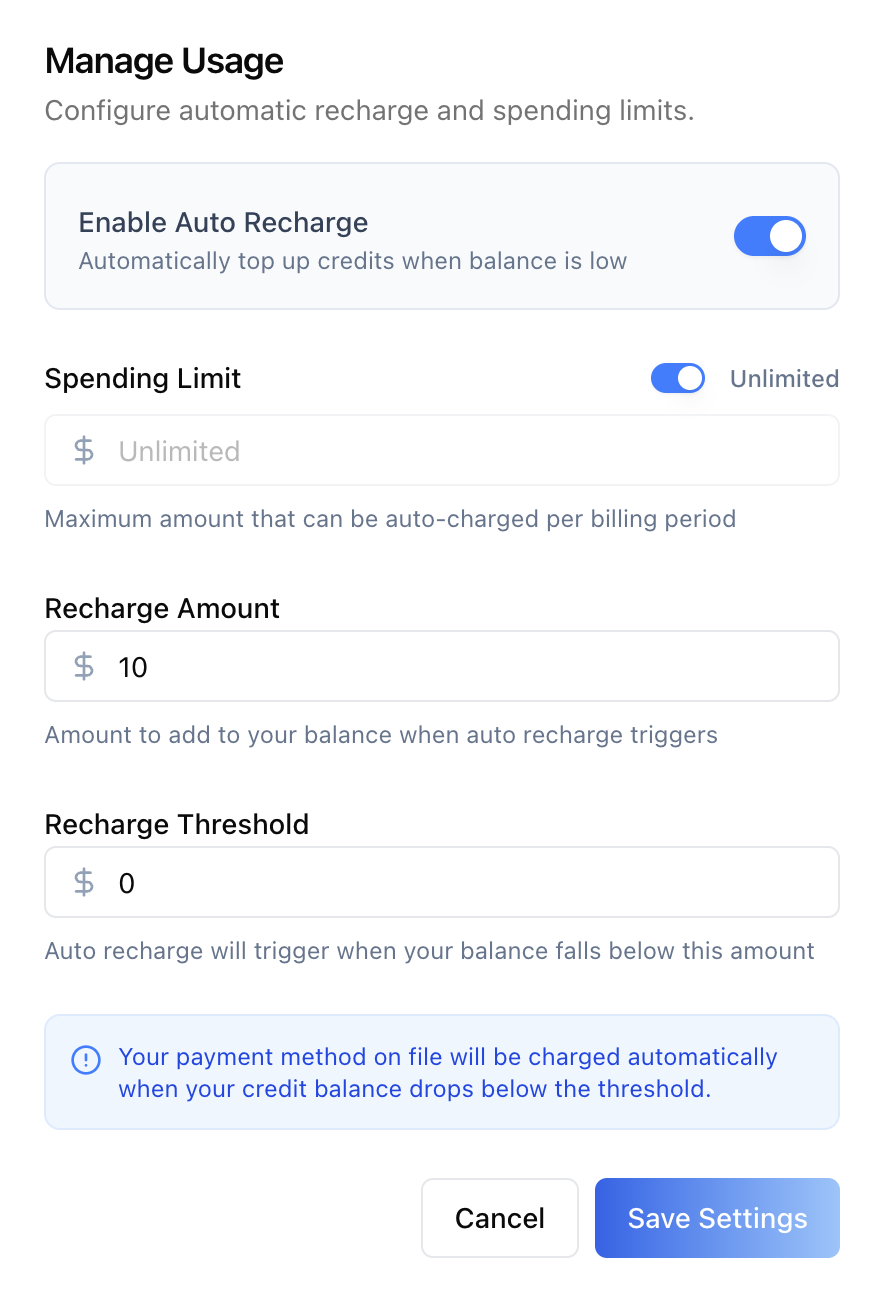
Enabled/Disabled badge, Threshold / Recharge Amount / Spending Limit stats, and a Manage Usage modal: enable toggle, spending limit (with an Unlimited toggle — the max auto-charged per billing period), recharge amount, and recharge threshold (top up when the balance falls below it).
Spend Limits (workspace-wide)
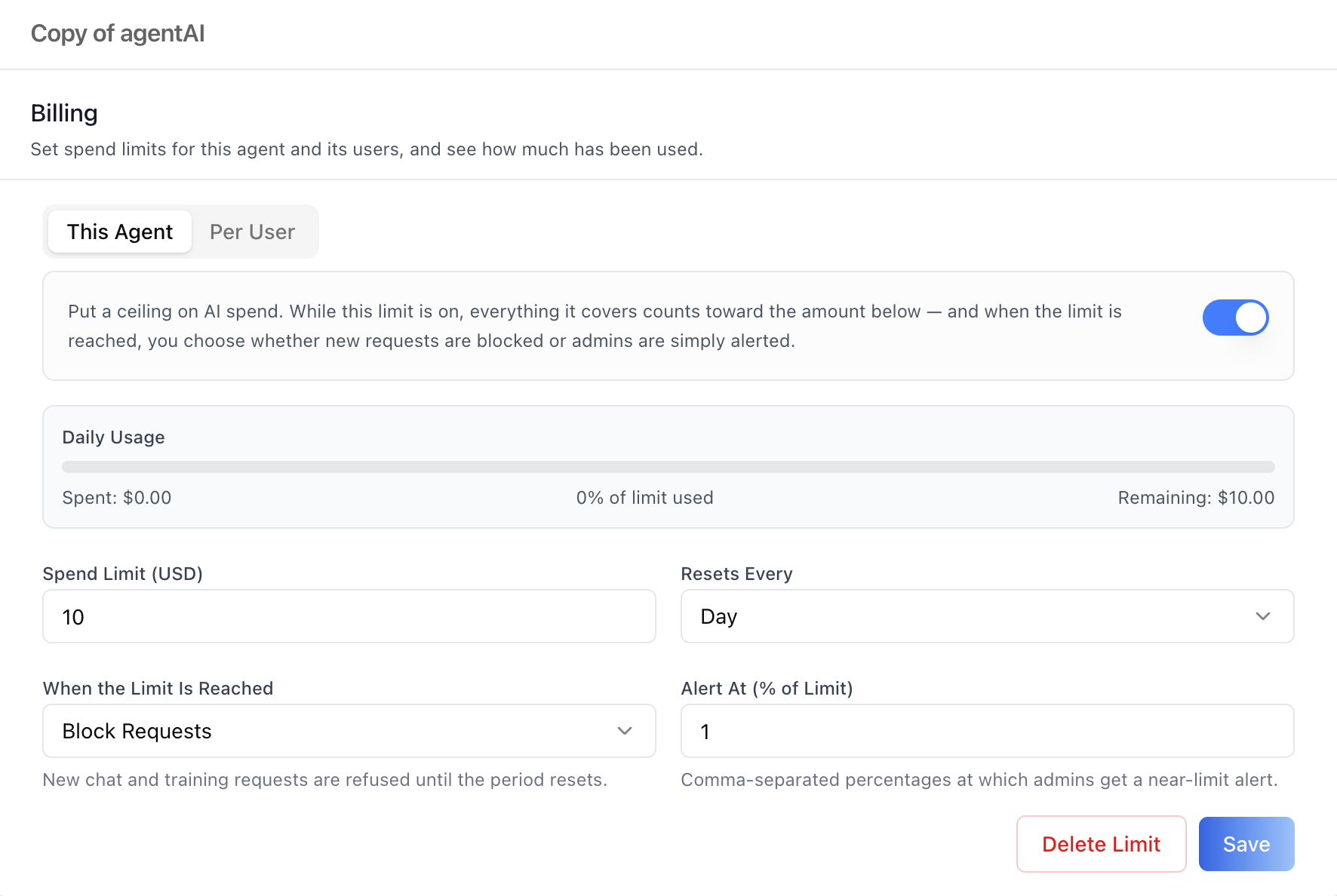
One limit covering everything all agents and users spend in this workspace — the tenant scope of the same spend-cap editor documented in /iblai-vibe-agent-billing (enable toggle, usage bar, Spend Limit, Resets Every, Block Requests / Alert Only, Alert At thresholds, Delete Limit / Save). Before a cap exists, the section shows the workspace's actual spend (this month + all time, from the financial analytics endpoint) so an admin can pick a sensible number.
Agent Limits
Every configured agent spend cap in the tenant, from the tenant-wide list endpoint (no per-agent fan-out):
- Search Agents — debounced autocomplete filter (min 2 chars);
filtering by an agent with no cap yet shows a Set a limit button for it.
- Table — Agent, Limit (
$10.00 / Day), Spent, Remaining, Status
(direct toggle that saves immediately, with Exceeded / Alert-only badges).
- Manage (slider icon) — opens that agent's full Billing editor
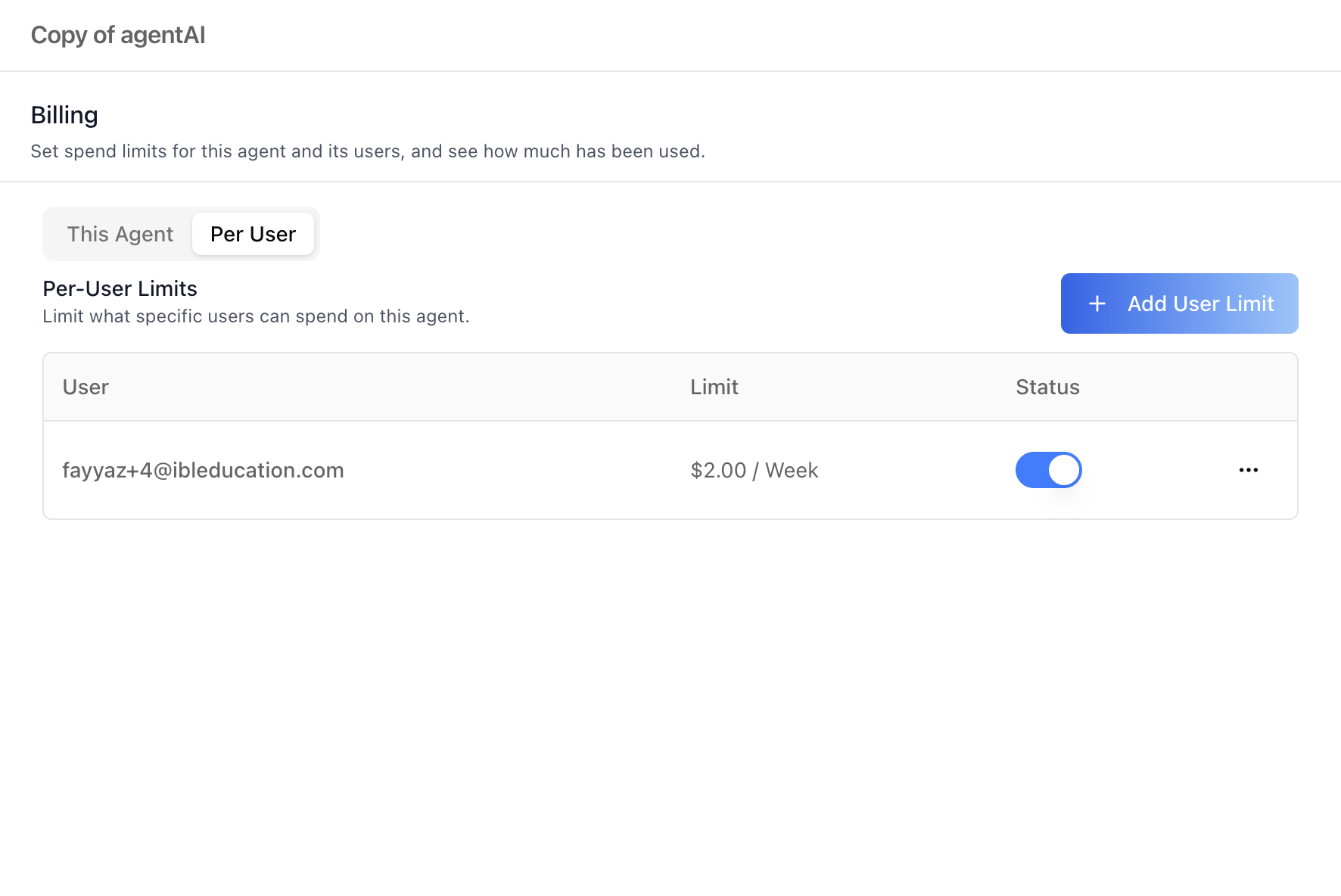
(AgentSpendCapsTab: This Agent + Per User sub-tabs) in a popup titled with the agent's name, exactly as in /iblai-vibe-agent-billing.
Related Exports
From @iblai/iblai-js/web-containers:
BillingTab— this surface. (The Spend Limits / Agent Limits
sections and the credits modals are internal to it.)
From @iblai/iblai-js/web-containers/next (see /iblai-vibe-agent-billing):
AgentSpendCapsTab— the per-agent editor the Agent Limits popup
hosts.
From @iblai/iblai-js/data-layer:
- Billing/credits:
useGetAccountBillingInfoQuery,
useGetCreditTransactionsQuery, useUpdateAutoRechargeInfoMutation, useTriggerAutoRechargeMutation, useCreateStripeCustomerPortalMutation, useRenewSubscriptionMutation
- Workspace cap:
useGetTenantSpendCapQuery,
useUpsertTenantSpendCapMutation, useDeleteTenantSpendCapMutation
- Agent-caps list:
useListAgentSpendCapsQuery(optionalmentor
filter)
- Actual-spend stats:
useGetFinancialStatsQuery
From @iblai/iblai-js/web-utils:
useStripeUpgrade— the plan-upgrade checkout flow.openExternalUrl— opens Stripe-hosted pages (portal/checkout).
Step 4: Verify
Run /iblai-vibe-ops-test before telling the user the work is ready:
pnpm build-- must pass with zero errorspnpm test-- vitest must pass- Start dev server and touch test:
``bash pnpm dev & npx playwright screenshot http://localhost:3000/settings/billing /tmp/billing.png ``
Important Notes
- Redux store: Must include
mentorReducerandmentorMiddleware initializeDataLayer(): 5 args (v1.2+)@reduxjs/toolkit: Deduplicated via webpack aliases innext.config.ts- Peer deps:
sonnerand@iblai/iblai-web-mentormust be installed
(pnpm add sonner @iblai/iblai-web-mentor)
- Import path:
BillingTabcomes from
@iblai/iblai-js/web-containers (base bundle) — unlike the agent settings tabs, which come from /next.
- Plan gating: Free/Trial plans see the Upgrade button and no
Add Credits / Auto Recharge; a paid plan without a payment method sees Manage Billing (Stripe portal) instead of Add Credits, and the Auto Recharge section stays hidden until a payment method exists.
- Conversion rate is per-environment: the credits↔USD rate is
resolved from the account fields or the latest top-up transaction — custom UI must not hardcode it.
- Workspace cap semantics: same contract as the agent scope —
first-run GET 404s until a cap is saved, the PUT is an upsert, counters are read-only, and a hard-block cap refuses requests with the spendcapexceeded 429. Full spend-caps REST tables live in /iblai-vibe-agent-billing; the tenant endpoints are spend-caps/tenant/ (GET/PUT/DELETE) and spend-caps/agents/ (tenant-wide list, ?mentor=<uuid> filter).
- Per-scope RBAC: each section 403s independently — Spend Limits
and Agent Limits render their own denied panels without hiding the Plan & Credits tab.
- Brand guidelines: BRAND.md