
SKILL.md
/iblai-vibe-agent-voice
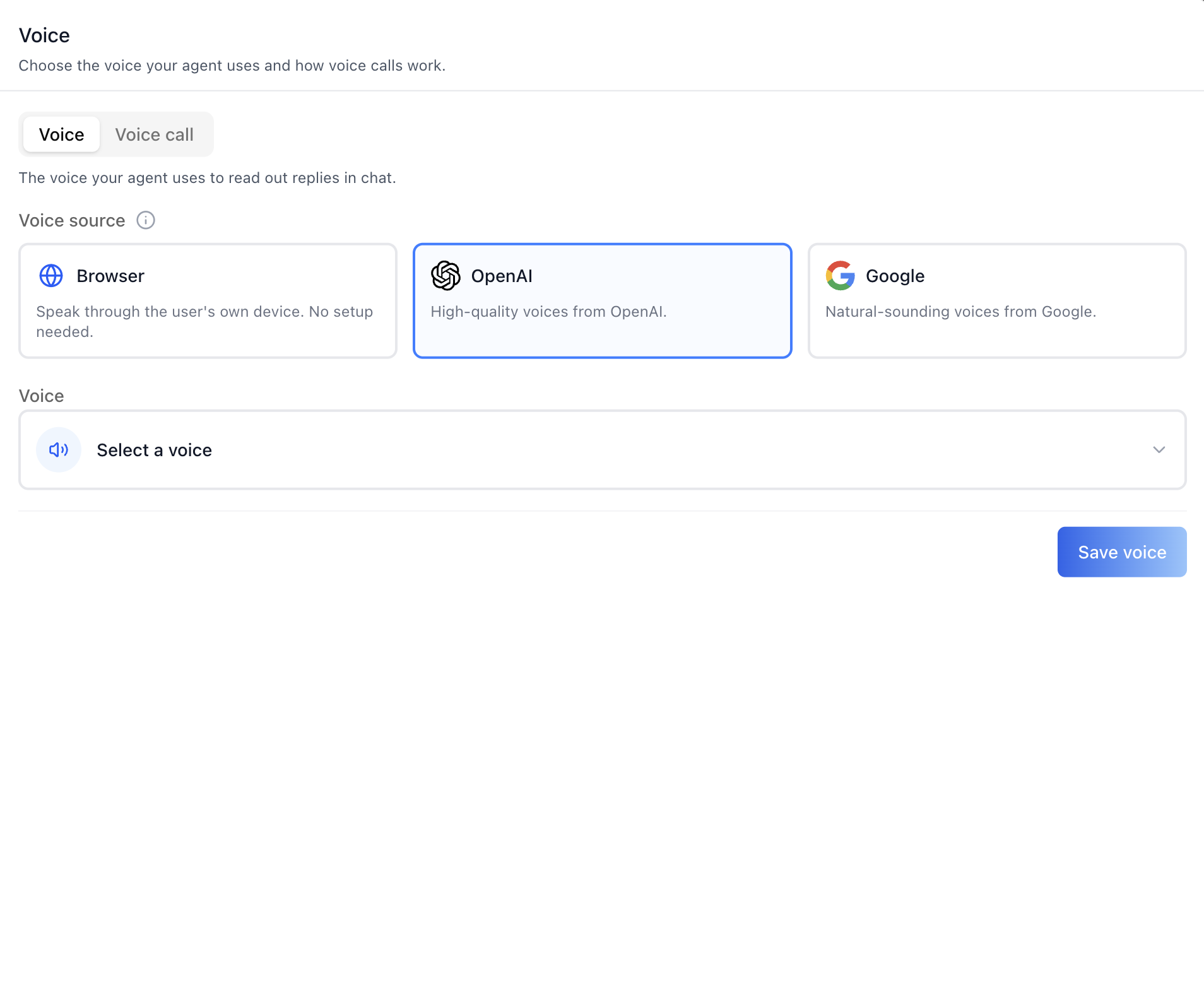
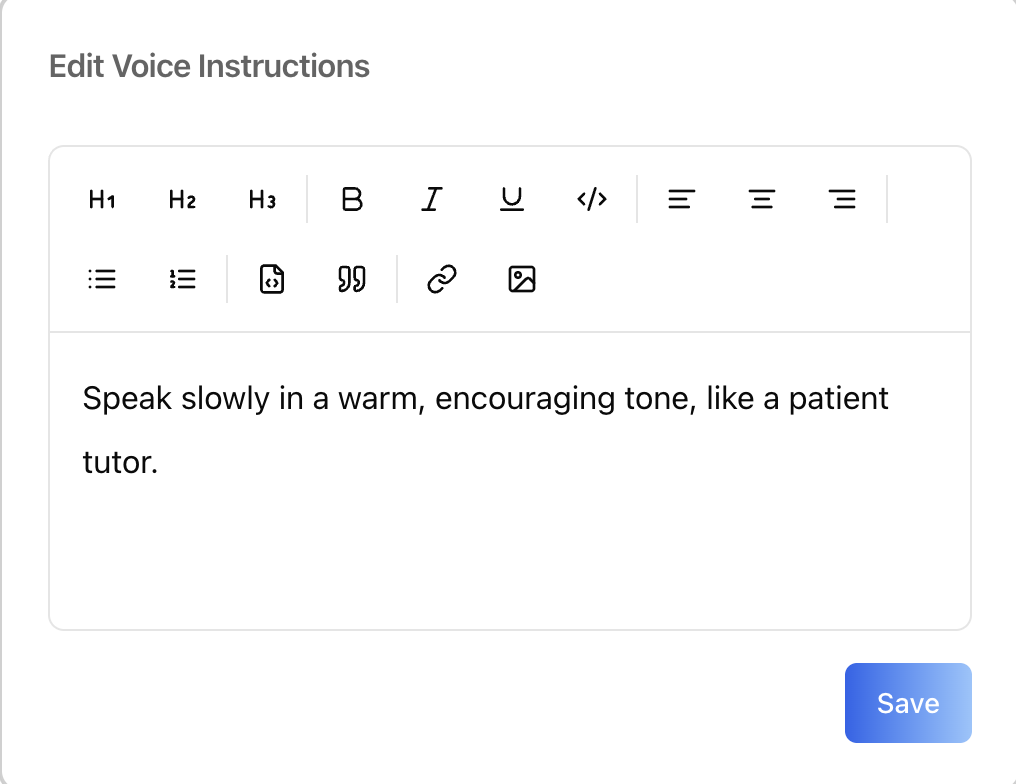
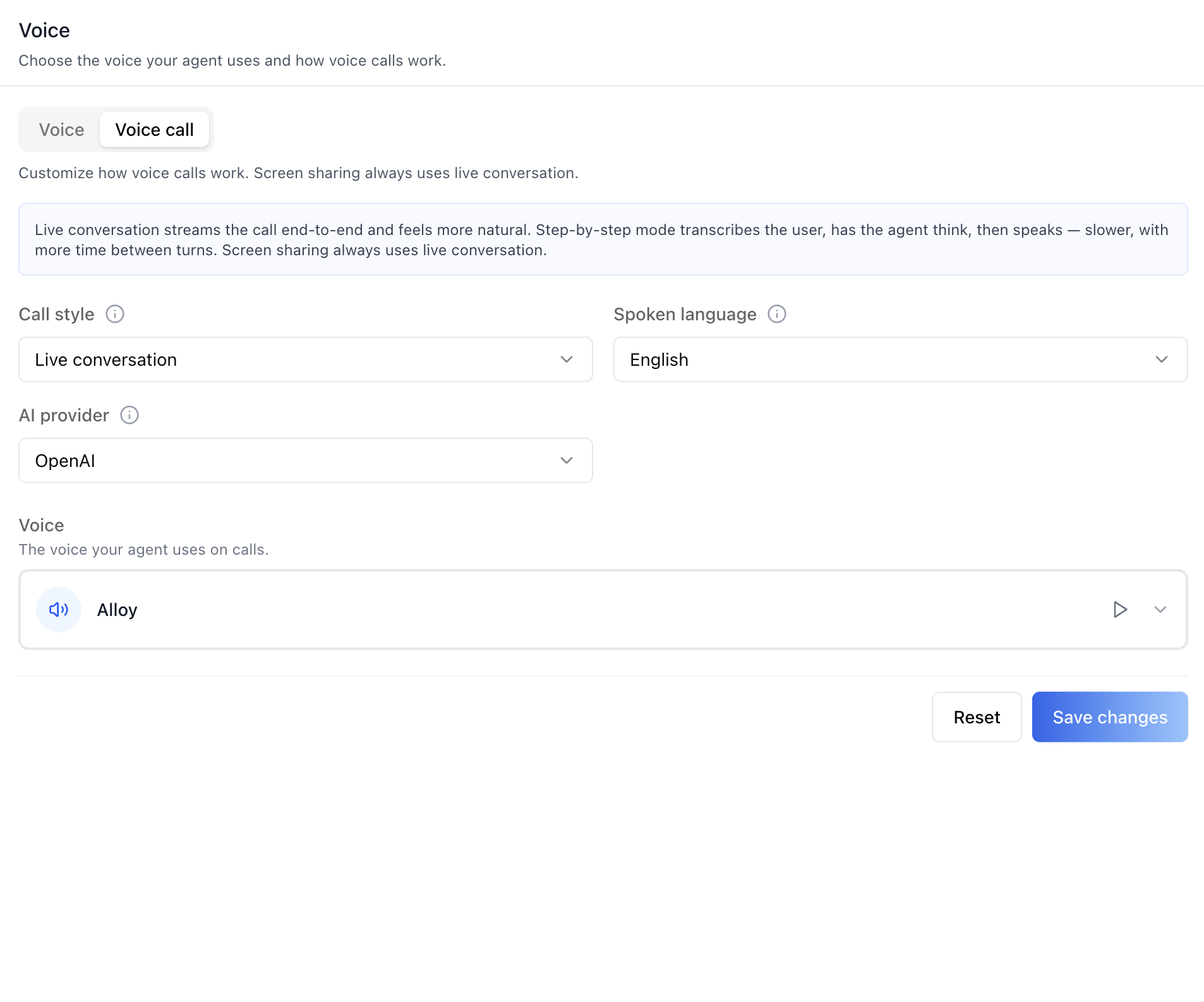
Add the agent Voice tab -- pick the voice your agent uses to read out chat replies, and configure how live voice calls work. The tab has two sub-tabs: Voice (choose a voice source -- Browser, OpenAI, or Google -- then pick a specific voice from a searchable, previewable picker, and optionally write Voice instructions, a style prompt for how the voice should deliver replies) and Voice call (call style, spoken language, AI provider, and the voice used on calls). This is one tab in the wider agent-settings family (access, api, datasets, disclaimers, embed, history, llm, memory, prompts, safety, settings, tools, voice). Each tab is a separate skill. All tabs share the same AgentSettingsProvider wrapper -- set it up once and mount as many tabs as you need.
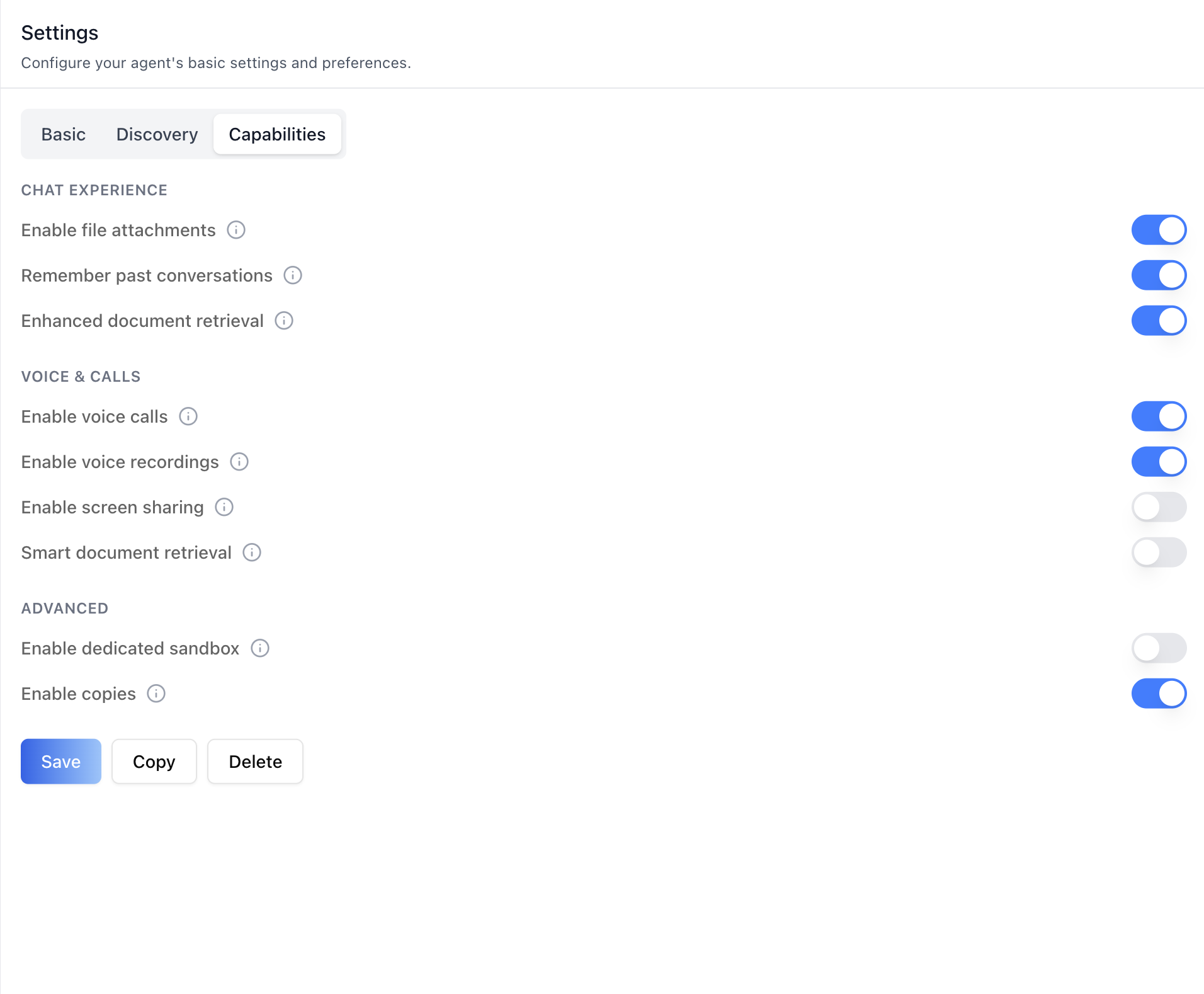
Enable voice calls first. The call features only do something once
voice calls are turned on for the agent. Toggle Enable voice calls in
the agent's Settings tab -> Capabilities (under "Voice & calls")
before configuring this tab. See/iblai-agent-setting.
Do NOT add custom styles, colors, or CSS overrides to ibl.ai SDK components. They ship with their own styling. Keep the components as-is. Do NOT implement dark mode unless the user explicitly asks for it.
When building custom UI around SDK components, use the ibl.ai brand:
- Primary:
#0058cc, Gradient:linear-gradient(135deg, #00b0ef, #0058cc) - Button:
bg-gradient-to-r from-[#2563EB] to-[#93C5FD] text-white - Font: System sans-serif stack, Style: shadcn/ui new-york variant
- Follow the component hierarchy: use ibl.ai SDK components
(@iblai/iblai-js) first, then shadcn/ui for everything else (npx shadcn@latest add <component>). Do NOT write custom components when an ibl.ai or shadcn equivalent exists. Both share the same Tailwind theme and render in ibl.ai brand colors automatically.
- Follow BRAND.md for
colors, typography, spacing, and component styles.
You MUST run /iblai-ops-test before telling the user the work is ready.
After all work is complete, start a dev server (pnpm dev) so the user can see the result at http://localhost:3000.
iblai.env is NOT a .env.local replacement — it only holds the 3 shorthand variables (DOMAIN, PLATFORM, TOKEN). Next.js still reads its runtime env vars from .env.local.
Use pnpm as the default package manager. Fall back to npm if pnpm is not installed.
Common setup (brand, conventions, env files, verification): see docs/skill-setup.md.
Prerequisites
- Auth must be set up first (
/iblai-auth) - MCP server + skills configured (
@iblai/mcpin.mcp.json) AgentSettingsProvidermust wrap the route (see/iblai-agent-setting
Step 2 if not already set up)
- Enable voice calls for the agent in the Settings tab ->
Capabilities (the Voice tab configures voice; the Settings tab turns the capability on)
- Ask the user for a real
mentorId(agent UUID). Do NOT invent one.
Step 1: Check Environment
Before proceeding, check for an iblai.env in the project root. Look for PLATFORM, DOMAIN, and TOKEN variables. If the file does not exist or is missing these variables, tell the user: "You need an iblai.env with your platform configuration. Download the template and fill in your values: curl -o iblai.env https://raw.githubusercontent.com/iblai/vibe/refs/heads/main/iblai.env"
Step 2: Mount AgentVoiceTab
// app/(app)/agents/[mentorId]/voice/page.tsx
"use client";

import { AgentVoiceTab } from "@iblai/iblai-js/web-containers/next";

export default function AgentVoicePage() {
  return (
    <div className="flex h-full flex-col bg-white">
      <AgentVoiceTab />
    </div>
  );
}
AgentVoiceTab reads tenantKey, mentorId, and username from AgentSettingsProvider (via useAgentSettings()) and handles its own fetching and saving. No props are required.
Deep-link to a sub-tab
The tab opens on Voice by default. To land on the Voice call sub-tab (e.g. from a host URL scheme), pass defaultSubTab:
<AgentVoiceTab defaultSubTab="callConfig" />;With Markdown rendering for the screen-sharing prompt
The Voice call sub-tab can show a screen-sharing prompt. Render it as rich text by passing renderPromptContent (mirrors AgentPromptsTab so one renderer can serve every prompt card in the modal):
import ReactMarkdown from "react-markdown";

<AgentVoiceTab
  renderPromptContent={(content) => <ReactMarkdown>{content}</ReactMarkdown>}
/>;
Step 3: Customize Labels (Optional)
AgentVoiceTab renders with the default agent-facing copy (AGENTVOICETAB_LABELS). Override any string via the labels prop. Pass a full VoiceTabLabels bundle (for a full agent re-skin) or a partial object (for one-off edits).
import {
  AgentVoiceTab,
  type VoiceTabLabels,
  AGENT_VOICE_TAB_LABELS,
} from "@iblai/iblai-js/web-containers/next";

<AgentVoiceTab
  labels={{
    header: {
      title: "Voice",
      description: "Pick the voice your agent speaks with.",
    },
    subTabs: { callConfig: "Calls" },
  }}
/>;
The label bundle is grouped by surface: header, subTabs, mentorVoice (the voice-source / picker copy), callConfig (the Voice call form), and toasts. Override only the keys you need.
Step 4: Use MCP Tools for Customization
get_component_info("AgentVoiceTab")
get_component_info("AgentSettingsProvider")
Tab surfaces
AgentVoiceTab is a single mounted component that renders two sub-tabs plus a voice picker. The corresponding web-containers source (under web-containers/.../edit-mentor-modal/tabs/voice-tab) is listed for reference -- these pieces are internal to AgentVoiceTab and are not mounted separately.
| Surface | Screenshot | Source component | What it shows |
|---|---|---|---|
| Voice sub-tab | voice | voice-tab (Voice sub-tab) |
Voice source cards -- Browser (the listener's own device, no setup), OpenAI, and Google -- plus a "Select a voice" trigger when OpenAI or Google is chosen, and a Save voice button |
| Voice picker | picker | voice-picker-modal / voice-picker |
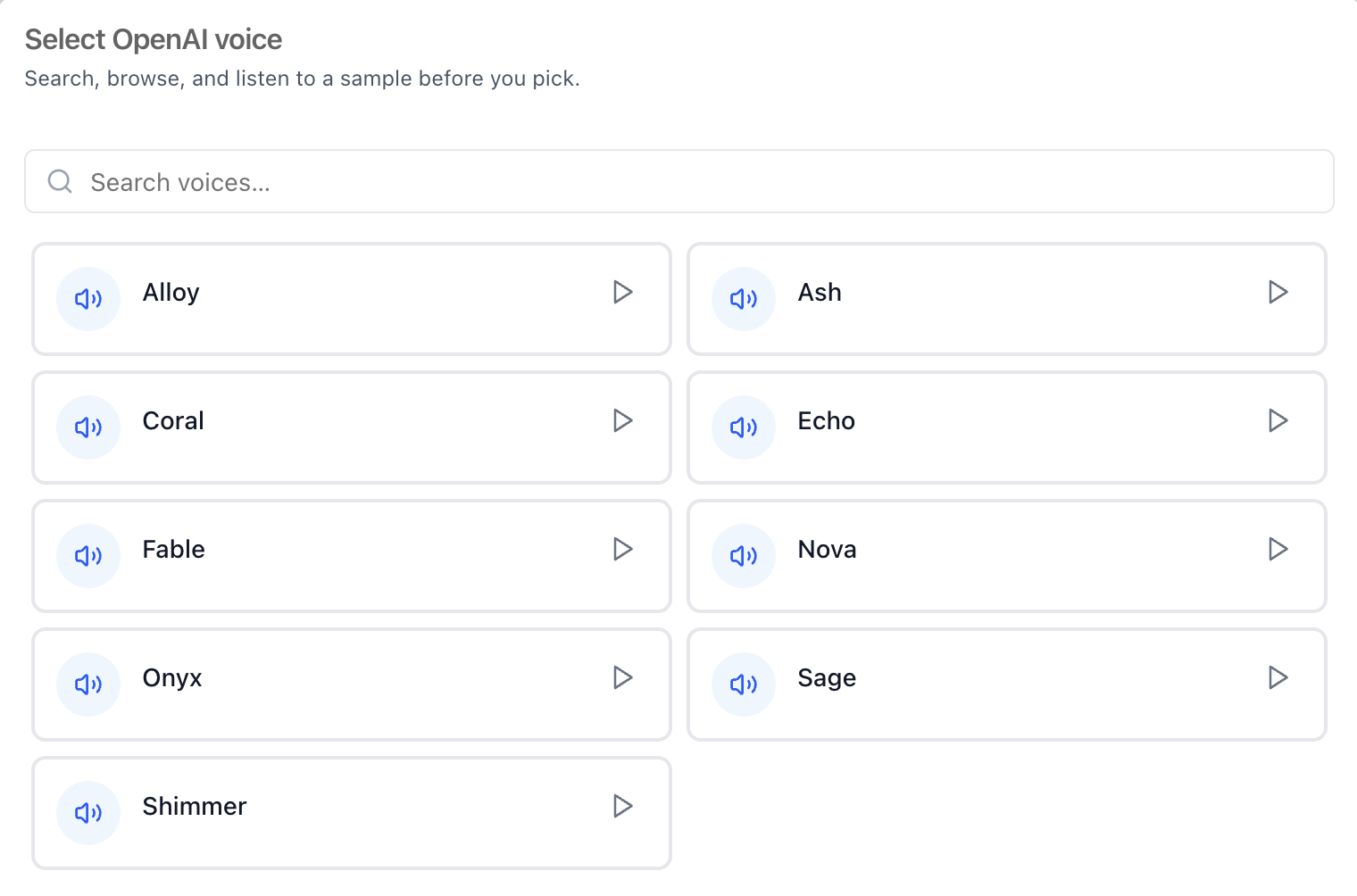
A searchable list of the provider's voices (e.g. OpenAI: Alloy, Ash, Coral, Echo, Fable, Nova, Onyx, Sage, Shimmer) with a play button to preview a sample before picking |
| Voice instructions | instructions / edit modal | voice-tab (Voice sub-tab) |
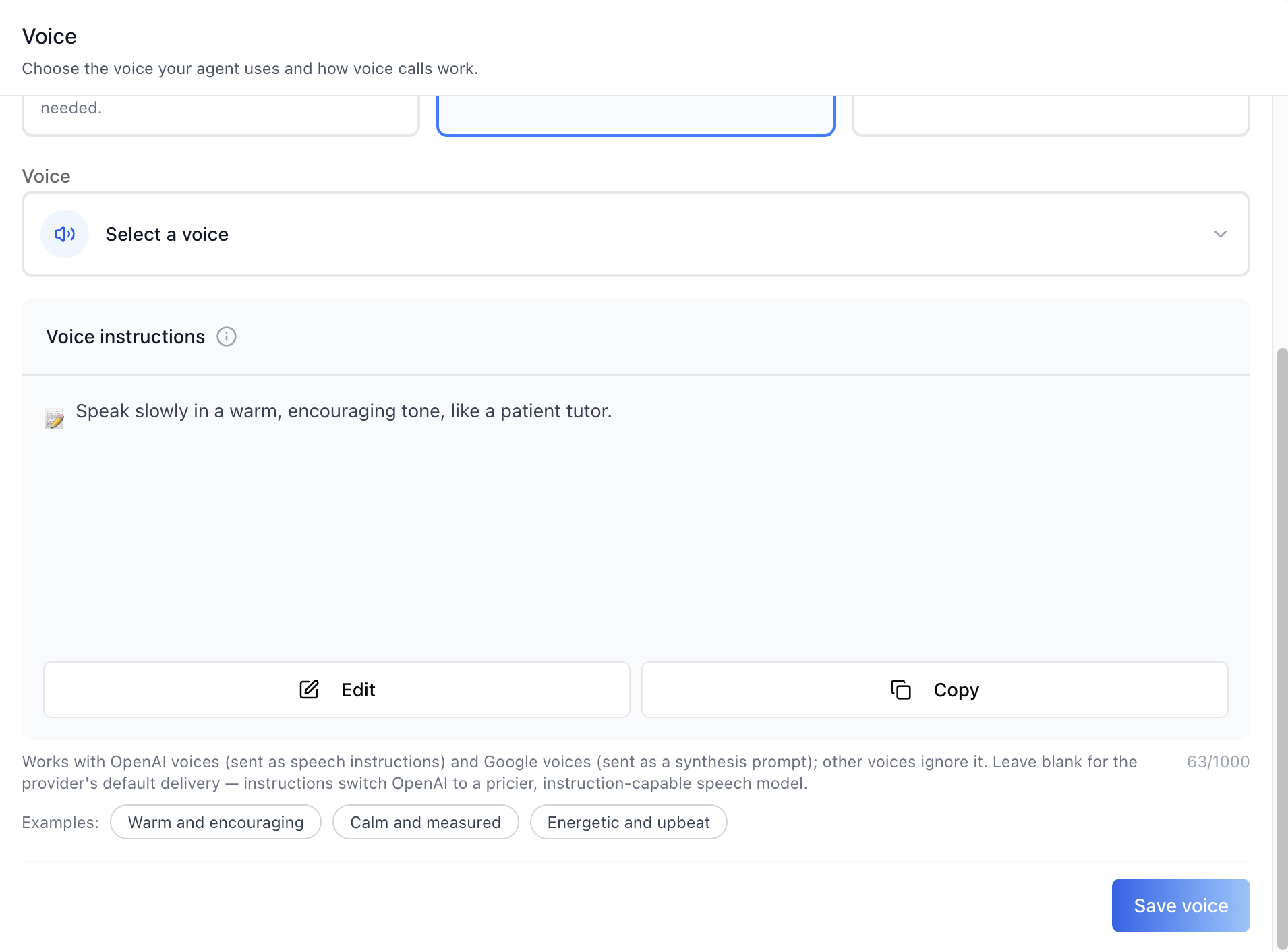
A free-form style prompt for how the voice delivers replies (e.g. "Speak slowly in a warm, encouraging tone, like a patient tutor."): a prompt card with Edit (rich-text modal) and Copy, an info tooltip, a 0/1000 character counter, and one-click example presets (Warm and encouraging / Calm and measured / Energetic and upbeat) |
| Voice call sub-tab | voice call | call-config-section |
Call style (Live conversation / Step-by-step), spoken language, AI provider, and the voice used on calls, with Reset and Save changes |
The Browser source speaks through the user's own device (no API voice). OpenAI and Google use a custom voice you pick from the voice picker. A voice is only sent to the backend on save when the user picks one this session -- leaving it untouched preserves the existing server-side value. The same "absent = keep" contract applies to Voice instructions: the field is only included in the save payload when it changed, and clearing it sends an empty string ("") — an absent field means "no change" on the backend.
<AgentVoiceTab> Props
Import from @iblai/iblai-js/web-containers/next.
| Prop | Type | Required | Description | |
|---|---|---|---|---|
labels |
DeepPartial<VoiceTabLabels> |
No | Override user-visible strings | |
defaultSubTab |
`'voice' \ | 'callConfig'` | No | Which sub-tab to open on. Defaults to 'voice' |
renderPromptContent |
(content: string) => ReactNode |
No | Render the screen-sharing prompt as rich text. Defaults to plain text | |
tenantKey |
string |
No | Identity override. Falls back to AgentSettingsProvider |
|
mentorId |
string |
No | Identity override (agent UUID). Falls back to AgentSettingsProvider |
|
username |
string |
No | Identity override. Falls back to AgentSettingsProvider |
|
enableRBAC |
boolean |
No | Toggle field-level gated-action prompts. Falls back to AgentSettingsProvider |
Related Exports
From @iblai/iblai-js/web-containers/next:
AGENTVOICETAB_LABELS-- the default agent-facing label bundle.VoiceTabLabels-- type for the full label bundle.
Step 5: Verify
Run /iblai-ops-test before telling the user the work is ready:
pnpm build-- must pass with zero errorspnpm test-- vitest must pass- Start dev server and touch test:
``bash pnpm dev & npx playwright screenshot http://localhost:3000/agents/<id>/voice /tmp/agent-voice.png ``
Important Notes
- Enable voice calls: The Voice tab configures voice; the capability is
turned on in the Settings tab -> Capabilities -> "Enable voice calls". Without it, the call features have no effect.
- Voice sources: Browser uses the listener's own device (no API
voice and no picker). OpenAI and Google require picking a voice.
- Voice instructions (
voice_instructionson the agent's settings):
a style prompt forwarded to the TTS provider on every synthesis — OpenAI voices receive it as speech instructions, Google voices as a synthesis prompt; other sources (including Browser) ignore it. Leave it blank for the provider's default delivery. Setting instructions switches OpenAI synthesis to a pricier, instruction-capable speech model — that trade-off is deliberate and surfaced in the help text. The 1000-character cap is a UI guardrail (the backend column is unbounded); the Save button blocks while over it.
- Redux store: Must include
mentorReducerandmentorMiddleware. initializeDataLayer(): 5 args (v1.2+)@reduxjs/toolkit: Deduplicated via webpack aliases innext.config.ts- Peer deps:
sonnerand@iblai/iblai-web-mentormust be installed
(pnpm add sonner @iblai/iblai-web-mentor)
- Shared provider:
AgentSettingsProvidermust wrap the route at a
layout level. See /iblai-agent-setting Step 2 for the full snippet.
- Brand guidelines: BRAND.md