
SKILL.md
/iblai-vibe-agent-memory
Add the agent Memory tab -- a toggle switch to enable/disable agent memory and a managed memories section with add, edit, bulk delete, and individual delete actions. This is one tab in the wider agent-settings family. All tabs share the same AgentSettingsProvider wrapper.
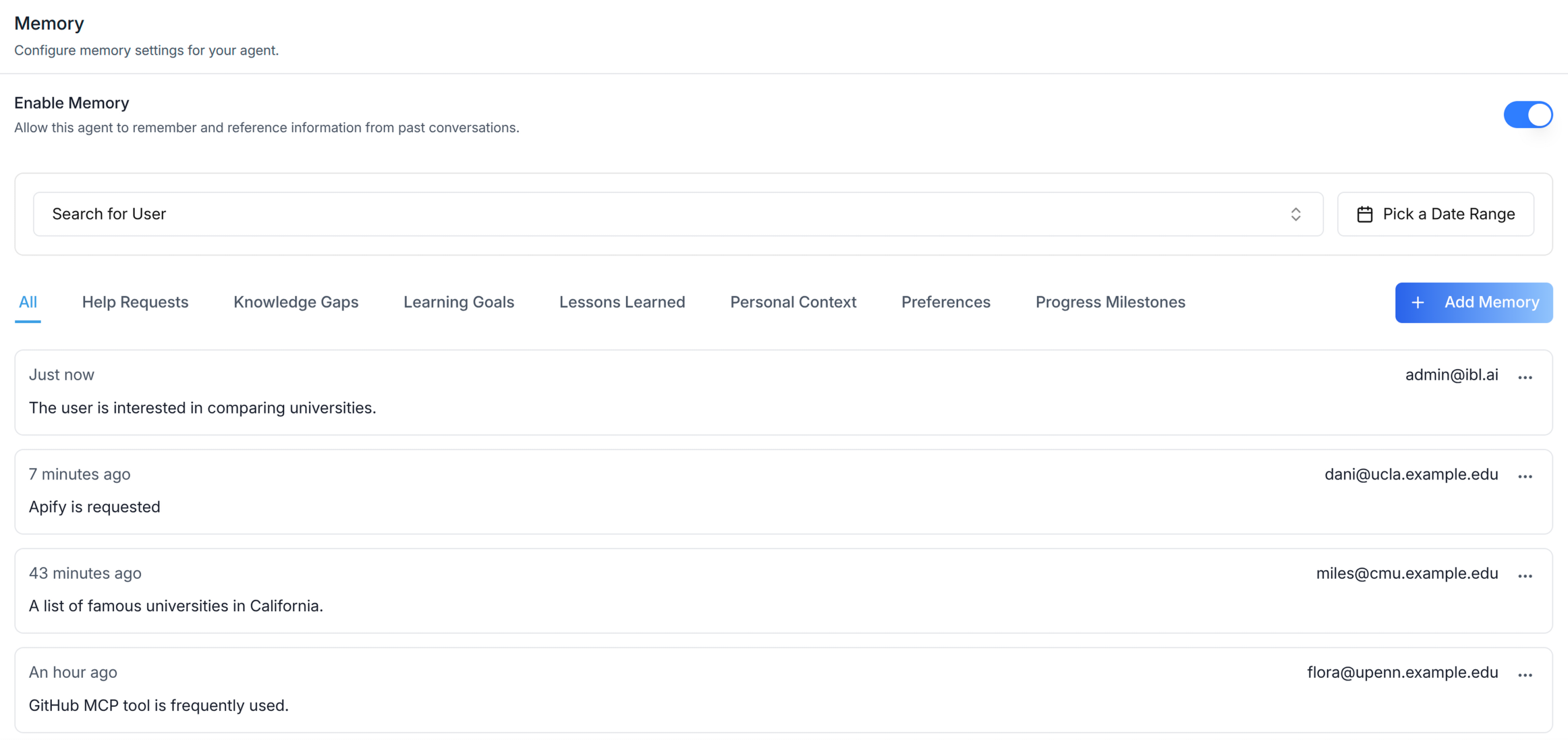
Do NOT add custom styles, colors, or CSS overrides to ibl.ai SDK components. They ship with their own styling. Keep the components as-is. Do NOT implement dark mode unless the user explicitly asks for it.
When building custom UI around SDK components, use the ibl.ai brand:
- Primary:
#0058cc, Gradient:linear-gradient(135deg, #00b0ef, #0058cc) - Button:
bg-gradient-to-r from-[#2563EB] to-[#93C5FD] text-white - Font: System sans-serif stack, Style: shadcn/ui new-york variant
- Follow the component hierarchy: use ibl.ai SDK components
(@iblai/iblai-js) first, then shadcn/ui for everything else (npx shadcn@latest add <component>). Do NOT write custom components when an ibl.ai or shadcn equivalent exists. Both share the same Tailwind theme and render in ibl.ai brand colors automatically.
- Follow BRAND.md for
colors, typography, spacing, and component styles.
You MUST run /iblai-vibe-ops-test before telling the user the work is ready.
After all work is complete, start a dev server (pnpm dev) so the user can see the result at http://localhost:3000.
iblai.env is NOT a .env.local replacement — it only holds the 3 shorthand variables (DOMAIN, PLATFORM, TOKEN). Next.js still reads its runtime env vars from .env.local.
Use pnpm as the default package manager. Fall back to npm if pnpm is not installed.
Common setup (brand, conventions, env files, verification): see docs/skill-setup.md.
Prerequisites
- Auth must be set up first (
/iblai-vibe-auth) - MCP server + skills configured (
@iblai/mcpin.mcp.json) AgentSettingsProvidermust wrap the route (see/iblai-vibe-agent-setting
Step 2 if not already set up)
- Ask the user for a real
mentorId(agent UUID). Do NOT invent one.
Step 1: Check Environment
Before proceeding, check for an iblai.env in the project root. Look for PLATFORM, DOMAIN, and TOKEN variables. If the file does not exist or is missing these variables, tell the user: "You need an iblai.env with your platform configuration. Download the template and fill in your values: curl -o iblai.env https://raw.githubusercontent.com/iblai/vibe/refs/heads/main/iblai.env"
Step 2: Mount AgentMemoryTab
// app/(app)/agents/[mentorId]/memory/page.tsx
"use client";

import { AgentMemoryTab } from "@iblai/iblai-js/web-containers/next";

export default function AgentMemoryPage() {
  return (
    <div className="flex h-full flex-col bg-white">
      <AgentMemoryTab />
    </div>
  );
}
Step 3: Customize Labels (Optional)
import { AgentMemoryTab } from "@iblai/iblai-js/web-containers/next";

<AgentMemoryTab
  labels={{
    header: { title: "Mentor memory" },
  }}
/>;
Step 4: Use MCP Tools for Customization
get_component_info("AgentMemoryTab")
get_component_info("AgentSettingsProvider")
<AgentMemoryTab> Props
Import from @iblai/iblai-js/web-containers/next.
| Prop | Type | Required | Description |
|---|---|---|---|
labels |
DeepPartial<MemoryTabLabels> |
No | Override user-visible strings |
Related Exports
From @iblai/iblai-js/web-containers/next:
AGENTMEMORYTAB_LABELS-- the default agent-facing label bundle.MemoryTabLabels-- type for the full label bundle.
Step 5: Verify
Run /iblai-vibe-ops-test before telling the user the work is ready:
pnpm build-- must pass with zero errorspnpm test-- vitest must pass- Start dev server and touch test:
``bash pnpm dev & npx playwright screenshot http://localhost:3000/agents/<id>/memory /tmp/agent-memory.png ``
Important Notes
- Redux store: Must include
mentorReducerandmentorMiddleware initializeDataLayer(): 5 args (v1.2+)@reduxjs/toolkit: Deduplicated via webpack aliases innext.config.ts- Peer deps:
sonnerand@iblai/iblai-web-mentormust be installed
(pnpm add sonner @iblai/iblai-web-mentor)
- Shared provider:
AgentSettingsProvidermust wrap the route at a
layout level. See /iblai-vibe-agent-setting Step 2 for the full snippet.
- Brand guidelines: BRAND.md
Memory REST API
Full REST reference: /iblai-api-agent-memory in iblai/api (npx skills add iblai/api). The tables below are the frontend-relevant summary.
For custom UI beyond <AgentMemoryTab>. All endpoints are prefixed with ${dmUrl}/api/ai-mentor/orgs/{org}/ where dmUrl is NEXTPUBLICAPIBASEURL and {org} is the platform/tenant key.
The system has three control levels: Platform (admin enables for tenant), Agent (admin/owner enables per agent), User (user opts in/out of capture and use).
User memory settings (per user opt-in)
| Method | Path | Purpose |
|---|---|---|
| GET | users/{user_id}/memsearch-settings/ |
Read autocaptureenabled, usememoryin_responses |
| PUT | users/{user_id}/memsearch-settings/ |
Update one or both flags |
Defaults are false if no settings row exists.
Platform config (tenant admin)
| Method | Path | Purpose |
|---|---|---|
| GET | users/{user_id}/memsearch-config/ |
Read enable_memsearch |
| POST | users/{user_id}/memsearch-config/ |
Set enable_memsearch |
| GET | users/{user_id}/memsearch-status/ |
Read-only enabled status for the tenant |
Agent toggle
| Method | Path | Purpose |
|---|---|---|
| PUT | users/{user_id}/mentors/{mentor}/settings/ |
Body includes enablememorycomponent: bool |
Global memories (apply across all agents)
| Method | Path | Purpose |
|---|---|---|
| GET | users/{user_id}/global-memories/ |
List. Params: page, pagesize (≤25), userid, startdate, enddate, search |
| POST | users/{user_id}/global-memories/ |
Create. Body { content } (≥10 chars). 409 if duplicate |
| DELETE | users/{userid}/global-memories/{memoryid}/ |
Delete |
Agent-specific memories (grouped by category)
| Method | Path | Purpose |
|---|---|---|
| GET | users/{userid}/mentors/{mentorid}/mentor-memories/ |
List grouped by category. Params: userid, startdate, enddate, mymemory |
| POST | users/{userid}/mentors/{mentorid}/mentor-memories/ |
Create. Body { category_slug, content } (≥10 chars) |
| PATCH | users/{userid}/mentors/{mentorid}/mentor-memories/{memory_id}/ |
Partial update of content and/or category_slug |
| DELETE | users/{userid}/mentors/{mentorid}/mentor-memories/{memory_id}/ |
Delete |
Memory categories (admin/owner)
| Method | Path | Purpose |
|---|---|---|
| GET | mentors/{mentor_id}/memory-categories/ |
List active categories |
| POST | mentors/{mentor_id}/memory-categories/ |
Create. 409 if slug exists |
| PATCH | mentors/{mentorid}/memory-categories/{categoryid}/ |
Update name/description/extraction prompt |
| DELETE | mentors/{mentorid}/memory-categories/{categoryid}/ |
Soft-delete (sets is_active=false) |
Default categories auto-created per agent: knowledgegaps, learninggoals, preferences, progressmilestones, personalcontext.
Common errors
400 validation (content <10 chars), 403 viewing another user's memories, 404 not found, 409 duplicate.
Visibility rule
Hide memory UI unless platform memsearch-status is enabled AND the agent's enablememorycomponent is true. Always show the user-level toggles so users can opt in/out.