
SKILL.md
/iblai-vibe-agent-billing
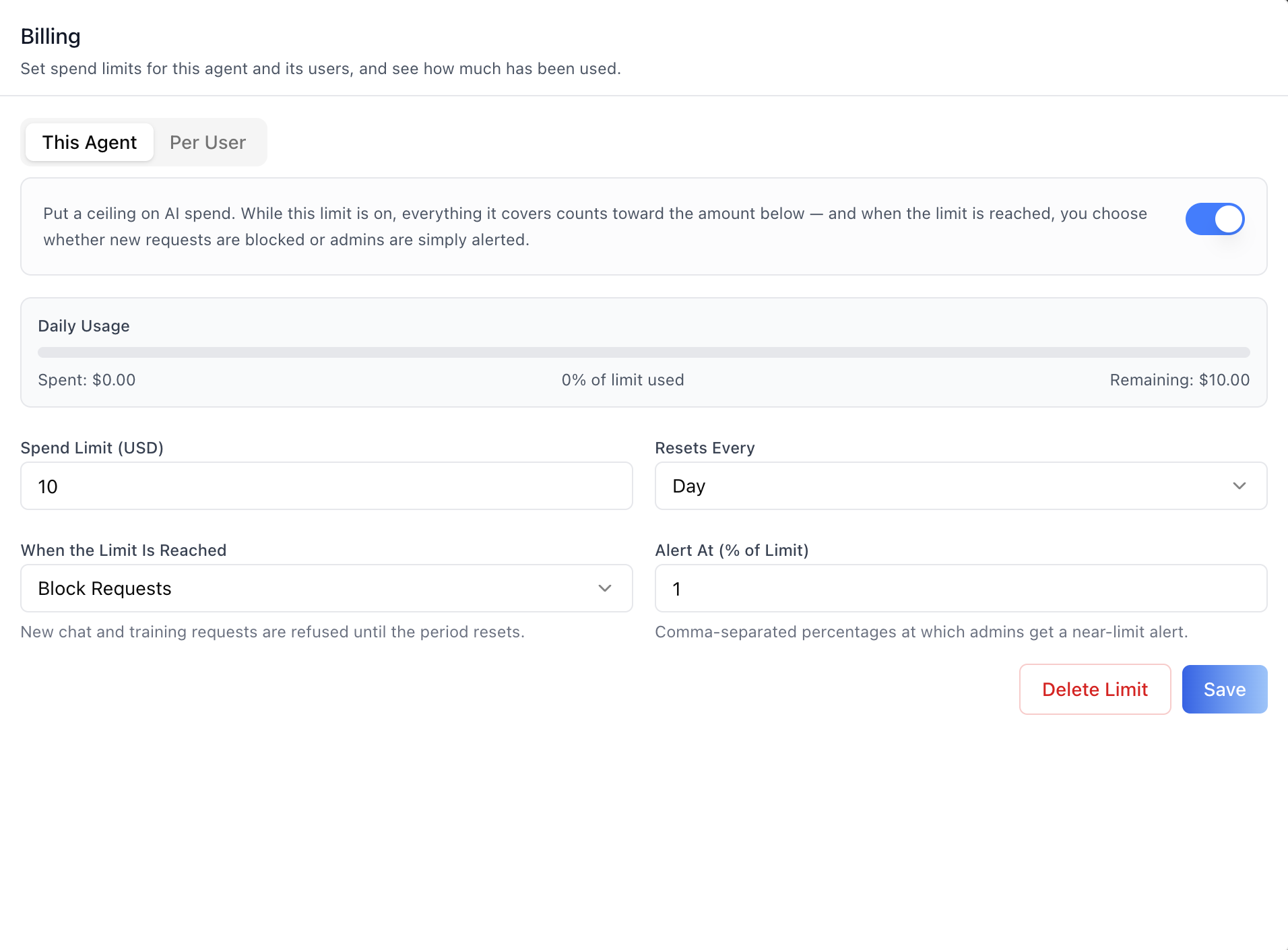
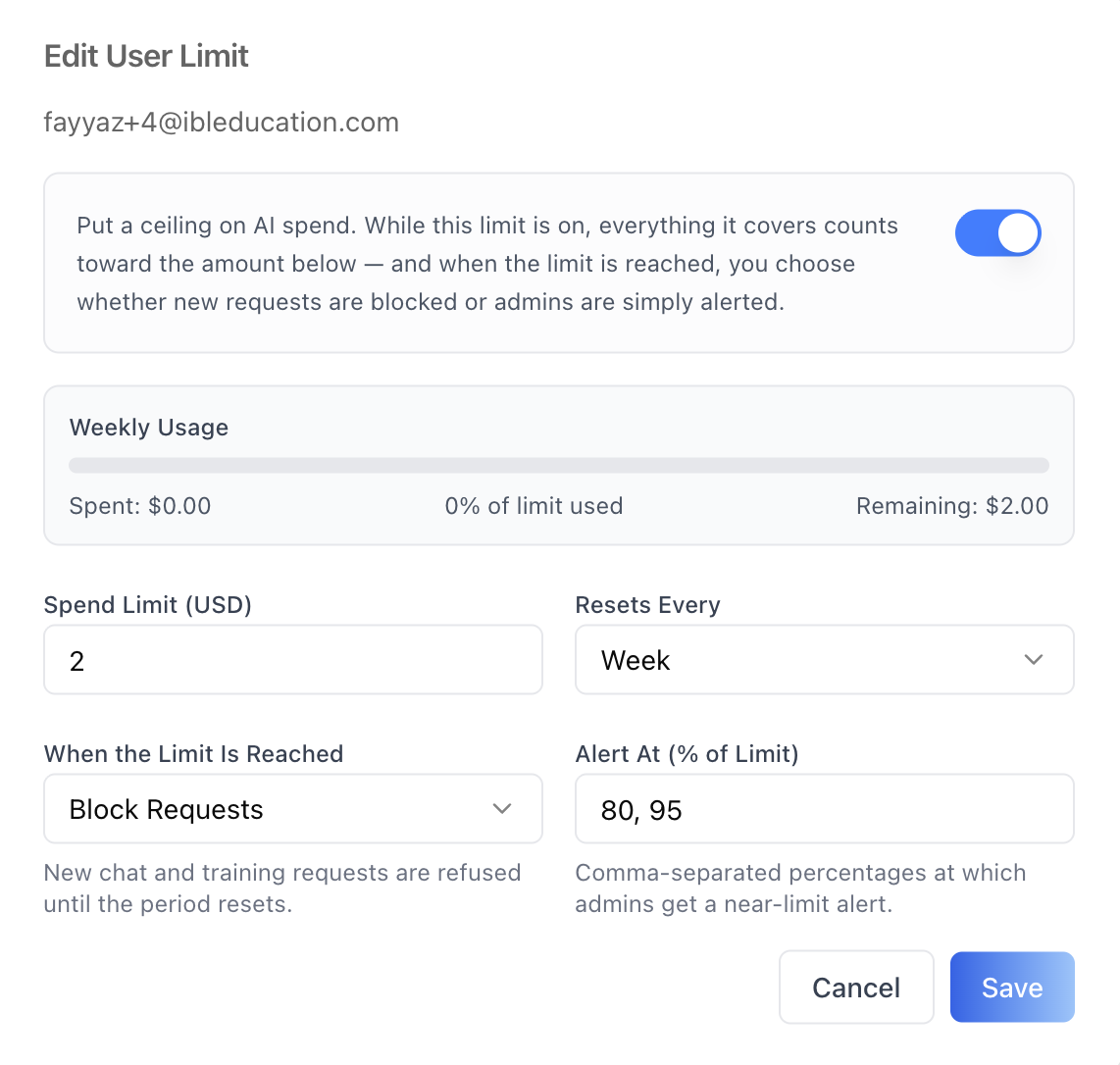
Add the agent Billing tab -- set LLM spend limits for this agent and its users, and see how much has been used. Two sub-tabs match the backend's agent-level scopes: This Agent (the agent's own spend cap) and Per User (explicit per-user limits on this agent, with the user picked through a platform-user search). Each limit has an enable toggle, a usage bar (spent / % used / remaining), a spend amount with a reset interval (day/week/month/year), an enforcement mode (Block Requests or Alert Only), and comma-separated alert thresholds at which admins get a near-limit alert. Enforcement is server-side — a blocked request is refused with a 429 / spendcapexceeded error until the period resets. This is one tab in the wider agent-settings family. All tabs share the same AgentSettingsProvider wrapper.
Do NOT add custom styles, colors, or CSS overrides to ibl.ai SDK components. They ship with their own styling. Keep the components as-is. Do NOT implement dark mode unless the user explicitly asks for it.
When building custom UI around SDK components, use the ibl.ai brand:
- Primary:
#0058cc, Gradient:linear-gradient(135deg, #00b0ef, #0058cc) - Button:
bg-gradient-to-r from-[#2563EB] to-[#93C5FD] text-white - Font: System sans-serif stack, Style: shadcn/ui new-york variant
- Follow the component hierarchy: use ibl.ai SDK components
(@iblai/iblai-js) first, then shadcn/ui for everything else (npx shadcn@latest add <component>). Do NOT write custom components when an ibl.ai or shadcn equivalent exists. Both share the same Tailwind theme and render in ibl.ai brand colors automatically.
- Follow BRAND.md for
colors, typography, spacing, and component styles.
You MUST run /iblai-vibe-ops-test before telling the user the work is ready.
After all work is complete, start a dev server (pnpm dev) so the user can see the result at http://localhost:3000.
iblai.env is NOT a .env.local replacement — it only holds the 3 shorthand variables (DOMAIN, PLATFORM, TOKEN). Next.js still reads its runtime env vars from .env.local.
Use pnpm as the default package manager. Fall back to npm if pnpm is not installed.
Common setup (brand, conventions, env files, verification): see docs/skill-setup.md.
Prerequisites
- Auth must be set up first (
/iblai-vibe-auth) - MCP server + skills configured (
@iblai/mcpin.mcp.json) AgentSettingsProvidermust wrap the route (see/iblai-vibe-agent-setting
Step 2 if not already set up)
- Ask the user for a real
mentorId(agent UUID). Do NOT invent one. - The spend-cap endpoints are RBAC-gated admin endpoints — a user
without access sees a friendly "no access" panel per sub-tab (403).
Step 1: Check Environment
Before proceeding, check for an iblai.env in the project root. Look for PLATFORM, DOMAIN, and TOKEN variables. If the file does not exist or is missing these variables, tell the user: "You need an iblai.env with your platform configuration. Download the template and fill in your values: curl -o iblai.env https://raw.githubusercontent.com/iblai/vibe/refs/heads/main/iblai.env"
Step 2: Mount AgentSpendCapsTab
// app/(app)/agents/[mentorId]/billing/page.tsx
"use client";

import { AgentSpendCapsTab } from "@iblai/iblai-js/web-containers/next";

export default function AgentBillingPage() {
  return (
    <div className="flex h-full flex-col bg-white">
      <AgentSpendCapsTab />
    </div>
  );
}
AgentSpendCapsTab reads tenantKey and mentorId from AgentSettingsProvider. No props are required for the standard mount.
Step 3: Customize Labels (Optional)
import { AgentSpendCapsTab } from "@iblai/iblai-js/web-containers/next";

<AgentSpendCapsTab
  labels={{
    header: { title: "Spend limits" },
    subTabs: { agent: "Agent limit", users: "User limits" },
  }}
/>;
Step 4: Use MCP Tools for Customization
get_component_info("AgentSpendCapsTab")
get_component_info("SpendCapUsage")
get_component_info("AgentSettingsProvider")
<AgentSpendCapsTab> Props
Import from @iblai/iblai-js/web-containers/next.
| Prop | Type | Required | Description |
|---|---|---|---|
labels |
DeepPartial<SpendCapsTabLabels> |
No | Override user-visible strings |
tenantKey |
string |
No | Identity override; defaults to AgentSettingsProvider |
mentorId |
string |
No | Identity override; defaults to AgentSettingsProvider |
headerClassName |
string |
No | Extra classes on the tab header (wide-dialog hosts widen padding) |
bodyClassName |
string |
No | Extra classes on the scrollable body |
What the tab renders
- Header — "Billing" title and "Set spend limits for this agent
and its users, and see how much has been used."
- This Agent / Per User sub-tabs — the two agent-level scopes. The
tab ratchets its height so switching sub-tabs never shrinks the dialog it is hosted in.
- No-access state — when the current user lacks permission for a
scope's endpoints (403), that sub-tab's content is replaced by a "no access" notice.
Shared spend-cap editor (both scopes)
Both sub-tabs edit a cap through the same SpendCapForm:
- Enable toggle — "Put a ceiling on AI spend…" capability gate.
While on, everything the limit covers counts toward the amount; fields collapse when toggled off. The flag rides along on save.
- Usage strip (saved caps only) — "Daily/Weekly/Monthly/Yearly
Usage" with a progress bar (blue, amber at ≥80%, red when exceeded) and Spent / % of limit used / Remaining figures, plus Disabled / Alert only / Exceeded badges as applicable.
- Spend Limit (USD) — positive decimal; sent as a 2-decimal
string.
- Resets Every — Day / Week / Month / Year.
- When the Limit Is Reached —
Block Requests(new chat and
training requests are refused until the period resets) or Alert Only (requests continue; admins are alerted).
- Alert At (% of Limit) — comma-separated percentages (default
80, 95) at which admins get a near-limit alert.
- Delete Limit (saved caps only) — confirmation dialog before
removal. Save creates the cap on first save and updates it after (the PUT is an upsert).
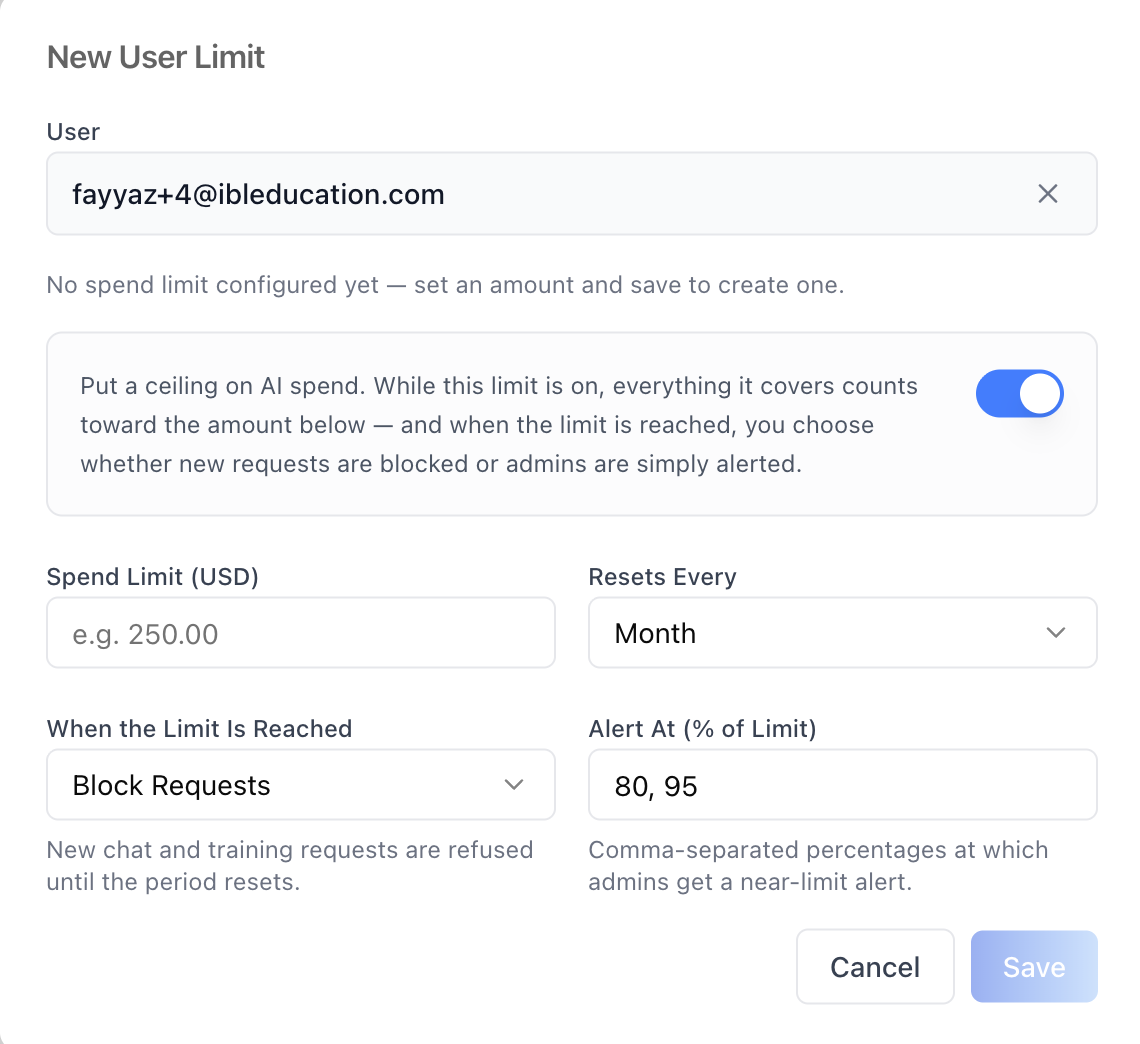
- Until a cap exists the form shows "No spend limit configured yet —
set an amount and save to create one."
This Agent sub-tab
The agent's own singleton spend cap — everything spent on this agent by anyone counts toward it.
Per User sub-tab
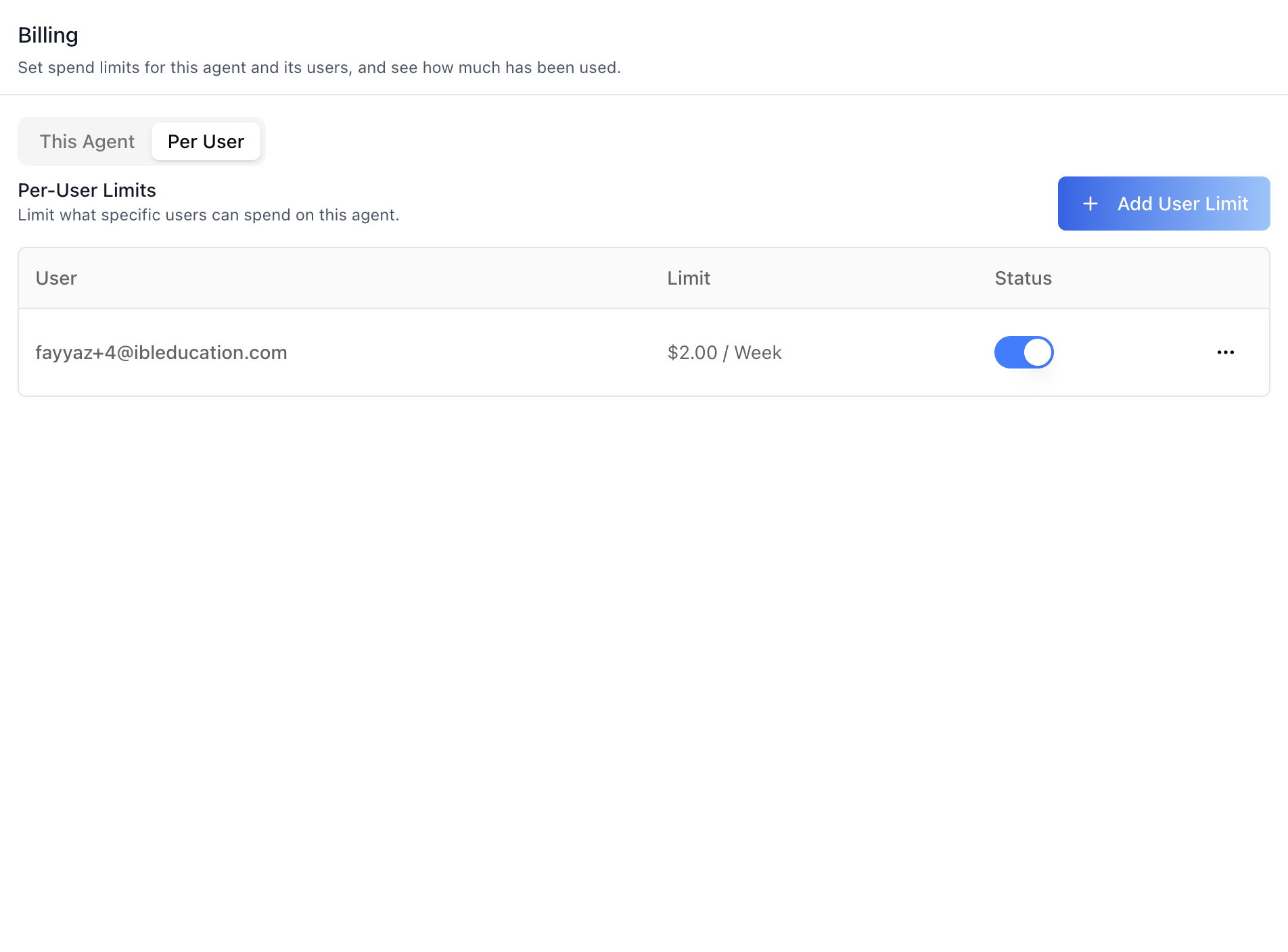
Explicit (user, agent) limits — "Limit what specific users can spend on this agent."
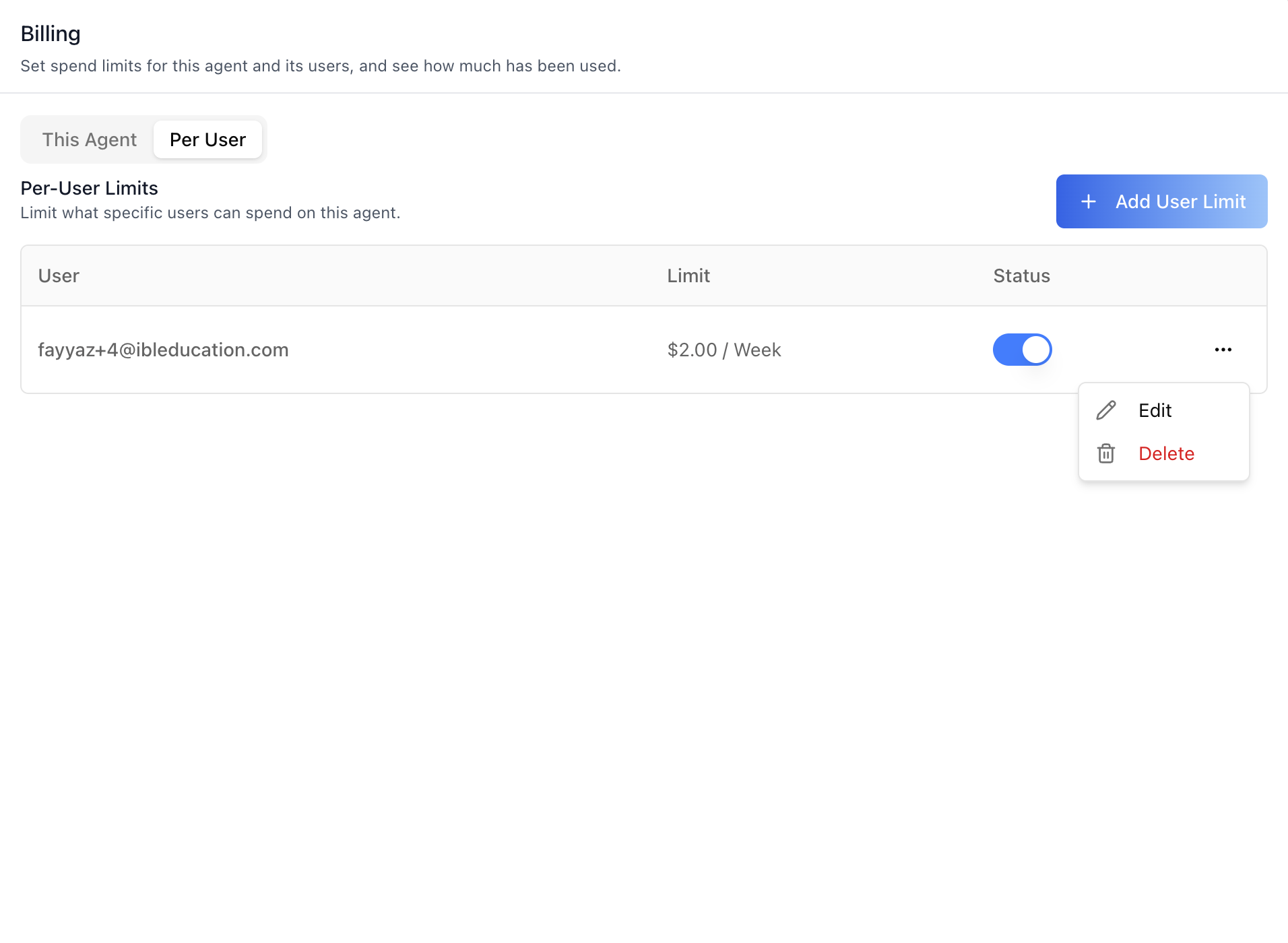
- Table — User (email-first, linked to the same profile viewer as
the Management tab; clicking the row opens it too), Limit ($2.00 / Week), Status (direct enable toggle that saves immediately, plus Exceeded / Alert-only badges), and a per-row actions menu (Edit / Delete).
- Add User Limit — opens the New User Limit modal: pick the user
through a debounced platform-user search (min 2 characters, email-only options — no free-text usernames), then fill the same spend-cap form. Edit mode skips the picker and goes straight to the form for the cap's user.
- Delete — confirmation dialog showing the user's email.
Related Exports
From @iblai/iblai-js/web-containers/next:
AGENTSPENDCAPSTABLABELS-- the default label bundle.SpendCapsTabLabels-- type for the full label bundle.AgentSpendCapsTabProps-- props type for the tab.SPENDCAPSSUB_TABS-- the sub-tab keys (agent,users).useSpendCaps-- the tab's data hook (caps + save/delete per
scope), for custom UI on the same endpoints.
SpendCapUsage,SpendCapUsageProps-- learner-safe usage
indicator for chat surfaces: renders progress zones and percentages only (never dollar amounts), a warning banner near a limit, and a blocked banner once a hard-block cap is exceeded. Renders nothing while everything is in the "ok" zone unless showWhenOk is set.
From @iblai/iblai-js/data-layer -- the RTK Query hooks and types the tab uses, for custom UI built on the same endpoints:
- Agent cap:
useGetAgentSpendCapQuery,
useUpsertAgentSpendCapMutation, useDeleteAgentSpendCapMutation
- Per-user caps:
useListAgentUserSpendCapsQuery,
useGetUserSpendCapQuery, useUpsertUserSpendCapMutation, useDeleteUserSpendCapMutation
- Tenant cap (workspace-wide singleton):
useGetTenantSpendCapQuery, useUpsertTenantSpendCapMutation, useDeleteTenantSpendCapMutation
- Tenant-wide agent-cap list:
useListAgentSpendCapsQuery
(optional mentor filter)
- Learner-safe status:
useGetSpendCapStatusQuery - Types:
SpendCap,SpendCapUpsertRequest,SpendCapIntervalType,
SpendCapEnforcement, SpendCapScope, SpendCapStatusSummary, SpendCapStatusItem, SpendCapStatusZone, SpendCapExceededErrorBody
SPENDCAPEXCEEDEDERRORCODE-- thespendcapexceedederror
code carried by blocked requests (HTTP 429 body / WebSocket frame), distinguishing a spend-cap block from a genuine provider rate limit.
Step 5: Verify
Run /iblai-vibe-ops-test before telling the user the work is ready:
pnpm build-- must pass with zero errorspnpm test-- vitest must pass- Start dev server and touch test:
``bash pnpm dev & npx playwright screenshot http://localhost:3000/agents/<id>/billing /tmp/agent-billing.png ``
Important Notes
- Redux store: Must include
mentorReducerandmentorMiddleware initializeDataLayer(): 5 args (v1.2+)@reduxjs/toolkit: Deduplicated via webpack aliases innext.config.ts- Peer deps:
sonnerand@iblai/iblai-web-mentormust be installed
(pnpm add sonner @iblai/iblai-web-mentor)
- Shared provider:
AgentSettingsProvidermust wrap the route at a
layout level. See /iblai-vibe-agent-setting Step 2 for the full snippet.
- First-run 404 is normal: the singleton GETs 404 until a cap is
first saved — that is the documented "no cap configured" state, not an error. The first Save creates the row.
- Counters are read-only:
currentspendusd,remaining_usd,
and isexceeded are reconciled server-side and only rendered — never submitted. Admins write intervaltype, maxcostusd (decimal string), enforcement, alert_thresholds, enabled.
- PUT is an upsert: the status toggles in the tables save
immediately by re-submitting the cap's current fields with the flipped enabled flag.
- Username key, email display: per-user caps are keyed by
username in the API; the UI deliberately shows the email everywhere. The user is picked via search — no free-text usernames.
- Enforcement is server-side: with
block, an exceeded cap makes
chat/training requests fail with HTTP 429 (or a WebSocket error frame) whose body carries errorcode: "spendcap_exceeded". Handle it in custom chat UI, or mount SpendCapUsage to warn users before they hit it.
- Three scopes: tenant (workspace-wide), agent, and per-user-per-
agent — the tightest applicable cap governs. This tab manages the two agent-level scopes; the workspace-wide limit belongs to the tenant settings Billing surface (/iblai-vibe-billing, which also lists every agent's cap in one place).
- RBAC: each scope's endpoints are gated separately; a 403 renders
the denied panel for that sub-tab only.
- Brand guidelines: BRAND.md
Spend Caps REST API
For custom UI beyond the tab. All endpoints are prefixed with ${dmUrl}/api/ai-mentor/orgs/{org}/ where dmUrl is NEXTPUBLICAPIBASEURL. Auth: Authorization: Token <token>. Use the canonical agents/ spelling — mentors/ is a deprecated alias.
Agent spend cap (singleton per agent)
| Method | Path | Purpose |
|---|---|---|
| GET | agents/{mentoruniqueid}/spend-cap/ |
Read (404 = no cap configured) |
| PUT | agents/{mentoruniqueid}/spend-cap/ |
Upsert — create or update |
| DELETE | agents/{mentoruniqueid}/spend-cap/ |
Remove the cap |
Upsert body:
{
  "interval_type": "day",
  "max_cost_usd": "10.00",
  "enforcement": "block",
  "alert_thresholds": [80, 95],
  "enabled": true
}intervaltype: day | week | month | year. enforcement: block | alertonly. maxcostusd is a decimal string. Responses add the read-only counters (currentspendusd, remainingusd, isexceeded, periodstartedat, lastreconciledat).
Per-user limits on an agent
| Method | Path | Purpose |
|---|---|---|
| GET | agents/{mentoruniqueid}/spend-caps/users/ |
List this agent's user caps |
| GET | agents/{mentoruniqueid}/spend-caps/users/{username}/ |
Read one (404 = none) |
| PUT | agents/{mentoruniqueid}/spend-caps/users/{username}/ |
Upsert (same body as above) |
| DELETE | agents/{mentoruniqueid}/spend-caps/users/{username}/ |
Remove |
The list may come back as a bare array or a DRF limit/offset envelope depending on deployment — the SDK slice normalizes both.
Tenant scope + tenant-wide listing
| Method | Path | Purpose |
|---|---|---|
| GET/PUT/DELETE | spend-caps/tenant/ |
Workspace-wide singleton cap |
| GET | spend-caps/agents/ |
Every configured agent cap in the tenant (?mentor=<uuid> filter) |
Learner-safe status
| Method | Path | Purpose |
|---|---|---|
| GET | spend-caps/status/{user_id}/ |
Zones + fill percentages for the caps covering this user (?mentor=<uuid> to include an agent's caps) — never dollar amounts. Non-admins may only read their own |
Enforcement error
A hard-block cap that is exceeded makes chat/training requests fail with HTTP 429 (or a WebSocket error frame):
{
  "error_code": "spend_cap_exceeded",
  "error": "...",
  "message": "...",
  "details": { "scope": "agent", "interval_type": "day", "mentor_unique_id": "..." }
}
Match on errorcode === "spendcapexceeded" (SPENDCAPEXCEEDEDERROR_CODE) — a genuine provider rate limit also uses status 429.